How to Write About Your Wedding Services Without Sounding Like Everyone Else
Learn practical wedding vendor copywriting tips to make your services sound clearer, more distinctive and more trustworthy to couples ready to enquire.
Karolina Kochanska
6/18/202612 min read
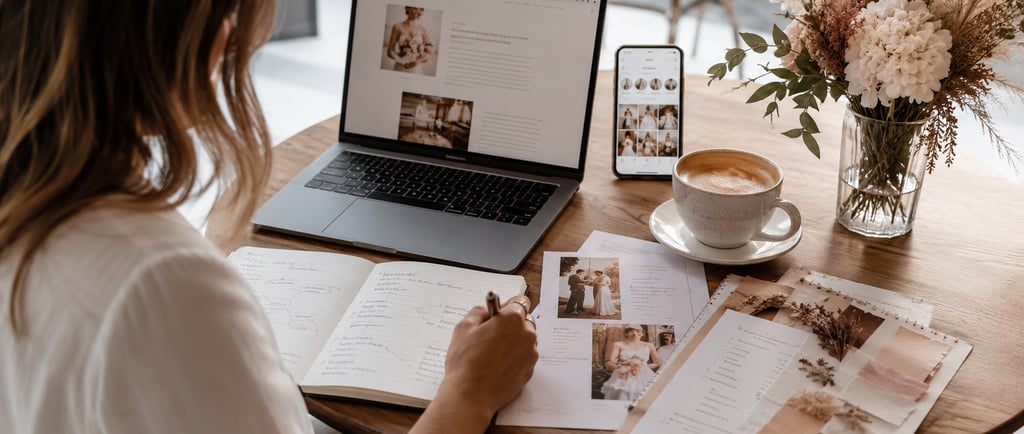
Most wedding vendors do not have a quality problem. They have a language problem.
Think about it. You have spent years — maybe decades — building real skill. You know how to read a room, calm a nervous couple, solve a last-minute crisis with a smile on your face and deliver something genuinely beautiful under pressure. You bring expertise, taste, emotional intelligence and an almost supernatural ability to make things feel effortless even when they absolutely are not.
And then you sit down to write your website copy and somehow end up with:
“Creating magical memories for your dream day.”
Or:
“Bespoke wedding experiences tailored to your unique love story.”
Or the classic:
“Passionate about love, laughter and happily ever afters.”
None of these phrases are technically wrong. The problem is that they are so overused they have stopped meaning anything at all. A photographer could write them. A florist could write them. A cake maker, a celebrant, a venue coordinator, a stationery designer — all of them could slap those exact words on their homepage and nobody would blink.
That is the real problem with most wedding vendor copy. It is not bad. It is just invisible.
Good wedding vendor copywriting does not need to be louder, fancier or more poetic than your competitors. It needs to be clearer, more specific and more honest about what you actually do and who you do it for. When you get that right, the couples who are genuinely right for you will feel it immediately. And the ones who are not will self-select out — which, honestly, is just as valuable.
This guide is going to show you how to write about your wedding services in a way that actually sounds like you, builds real trust and gives couples a clear reason to choose you over everyone else with a similar Instagram aesthetic.
Why Wedding Vendor Copy All Sounds the Same
Here is something that makes total sense once you think about it. Wedding vendors reach for emotional language because weddings are emotional. Love. Magic. Memories. Moments. Dreams. Forever. Of course these words show up everywhere — they belong in this industry.
The issue is not the words themselves. It is that when every single vendor uses them in the same way, they dissolve into background noise. They stop registering as meaningful and start functioning more like wallpaper.
A photographer, a celebrant, a florist and a venue could all genuinely describe themselves as creating “beautiful, personalised wedding experiences” — and all four of them would be telling the truth. But that sentence does not help a couple understand what any of them actually do, how they work, who they are best suited to or why they should pick one over another.
Couples need more than warm language. They are making significant financial and emotional decisions, often for the first time, with limited knowledge of how the industry works. They are trying to work out whether you are the right fit for their specific wedding, their specific style and their specific needs. Generic copy cannot help them do that, no matter how beautifully it is written.
What couples actually need to understand from your copy is fairly straightforward. They want to know what you do, who you are best suited to, what your process feels like, what problems you solve, why your work is different and what happens after they enquire. If your copy skips over those questions in favour of sounding atmospheric and aspirational, it may look gorgeous and still fail to convert.
Start With What Couples Are Actually Buying
Here is a reframe that changes everything about how you write. Couples are not buying your product or service. They are buying the outcome, the feeling and the confidence that your service creates.
A celebrant is not selling a ceremony. They are selling calm guidance through an unfamiliar process, legal clarity, personal storytelling and the reassurance that the ceremony will not feel awkward or generic or like something downloaded from a template.
A photographer is not selling images. They are selling comfort in front of the camera, trust on the day, the emotional weight of seeing a moment captured exactly as it felt and the confidence that the important things will not be missed.
A florist is not selling flowers. They are selling atmosphere, considered colour, seasonal relevance, design judgment and the feeling that the space has been thought through rather than just filled.
A planner is not selling coordination. They are selling calm, structure, fewer “wait, what do we do now?” moments and the ability to actually enjoy the lead-up to the wedding without it becoming a second job.
A stylist is not selling décor. They are selling visual cohesion, setup confidence and a wedding that looks intentional from every angle rather than like a Pinterest board that got slightly out of hand.
A venue is not selling a space. It is selling mood, logistics, guest comfort, natural light, photo opportunities and a sense of place that makes the whole day feel grounded.
Better copy starts the moment you stop describing your service only from your own perspective and start writing about what it does for the couple sitting on the other side of the screen.
Replace Vague Promises With Specific Value
Vague copy can sound polished on the surface. But it does not do any real work.
Take this sentence: “We create unforgettable wedding experiences tailored to your unique love story.”
It sounds fine. It is not offensive. But it could genuinely describe almost any wedding vendor in any category. It tells the couple nothing specific, nothing useful and nothing that helps them decide whether you are right for them.
Now compare it to this: “We help relaxed, modern couples plan a ceremony that feels genuinely personal without tipping into overly formal — from the legal wording to the vows, readings and the flow of the day itself.”
Now we know who this is for. We know what the vendor helps with. We know the style they suit. We know what problem they help avoid. We know what to expect. That is five things in two sentences, and none of it required the words “magical” or “unforgettable.”
Specificity is not just a copywriting technique. It is a trust signal. When your copy gets into the details, couples register — consciously or not — that you actually know what you are doing.
The “So What?” Test Every Vendor Should Be Running
This is probably the most useful editing tool in wedding copywriting and almost nobody uses it.
Every time you write a feature, follow it immediately with the question: so what?
“We use seasonal flowers.” So what? So your arrangements feel fresh, considered and aligned with what is naturally at its best around your wedding date — rather than forced or out of place.
“We include an engagement shoot.” So what? So you can get comfortable in front of the camera before the wedding day, which means the portraits on the actual day feel more natural and less like a chore.
“We provide a professional PA system.” So what? So your guests can actually hear your vows, readings and the legal wording, even in an outdoor ceremony with wind, ambient noise and a venue that was not designed for speeches.
“We offer full-service wedding planning.” So what? So you have one experienced person managing your supplier communication, your timeline, your styling decisions and your final-month logistics, instead of trying to coordinate fifteen different people yourself.
“We offer custom signage.” So what? So your welcome sign, seating chart, menus and bar sign all feel visually connected, instead of looking like they came from four different sources.
Features describe what you offer. Benefits explain why it matters. Couples buy benefits.
Say Who You Are For — And Mean It
One of the fastest ways to make your copy instantly more specific is to name your ideal couple. Not vaguely — actually name them.
Not every vendor is right for every wedding, and that is genuinely a strength. Trying to appeal to everyone is one of the main reasons copy ends up sounding like nothing in particular.
For couples who want a relaxed ceremony that still feels meaningful. For design-led couples who care deeply about atmosphere, flow and the guest experience from arrival to last dance. For camera-shy couples who want natural, unposed photos without spending half their wedding day away from their guests. For busy couples who want expert planning support without handing over every single decision. For families planning a warm, inclusive celebration that genuinely brings everyone into the moment.
When couples read copy that describes them specifically, something shifts. They stop browsing and start paying attention. The right people feel seen. The wrong people quietly move on. Both outcomes are good for your business.
Use Contrast to Clarify Your Style
Couples often know what they do not want before they know how to articulate what they do want. Contrast is a remarkably effective way to help them understand your approach without resorting to overused adjectives.
Personal, not performative. Elegant, not overstyled. Relaxed, not rushed. Guided, not scripted. Editorial, not stiff. Organised, not overwhelming.
These are short but they are doing a lot of work. They immediately create a picture of your style by showing both what you are and what you are deliberately not.
Then you expand it. “Our ceremonies are personal, not performative. That means we include your story, your people and your promises — without turning the whole thing into something that feels staged or uncomfortable for everyone in the room.”
Or: “Our planning style is organised, not overwhelming. You will always know what needs to happen next, but you will not be buried in spreadsheets unless that is genuinely how you like to operate.”
Contrast gives your copy a clear shape. It helps people understand your point of difference without leaning on words like “unique” or “bespoke” that have been emptied of meaning through overuse.
Write About the Problems Couples Actually Lie Awake Thinking About
Wedding copy often avoids anything that sounds like a problem, because the industry defaults to aspirational and beautiful. But couples have real concerns, and pretending otherwise does not make your copy more appealing — it just makes it feel slightly disconnected from reality.
They worry about running late. About feeling awkward. About choosing the wrong supplier and not realising until it is too late. About guests being bored. About the ceremony feeling generic. About photos that look stiff. About flowers that do not match the brief. About styling that looks unfinished. About budget creep. About the day not feeling like them.
You do not need to make your copy negative to acknowledge these things. You just need to show that you understand what couples are trying to avoid, not just what they are hoping to achieve.
Instead of “We capture authentic moments” — try “We give just enough direction so you do not feel awkward, then step back so the real moments can happen without us in the way.”
Instead of “We design beautiful wedding florals” — try “We help you choose flowers that suit your venue, season and budget, so the whole space feels intentional rather than overfilled or underconsidered.”
Instead of “We offer seamless wedding day coordination” — try “We keep the moving parts clear, from supplier timelines to final setup details, so you are not answering logistics questions while someone is trying to do your hair.”
Problem-aware copy converts better because it reflects how couples are actually thinking when they are making decisions.
Make Your Process Visible
One of the most common reasons couples hesitate before enquiring is simple uncertainty. They like your work. They are interested. But they do not know what happens next, and that uncertainty creates enough friction to make them close the tab.
What happens after I contact you? Will you send pricing? Do we have a call? How much guidance do you give? When do I need to make decisions? How involved do I need to be? Will you help with ideas or do I need to come with a clear brief?
A clear, simple process section answers all of that before the question is even formed.
Enquire with your date and venue — send through the basics so availability can be confirmed and the conversation can start from a grounded place. Discovery call — a conversation about your wedding style, priorities, guest numbers and what kind of support actually makes sense for you. Tailored proposal — outlining the service, inclusions, investment and next steps, clearly. Planning the details — timelines, design direction, ceremony flow, supplier coordination. You will always know what is happening and when. The day itself — you get to be present and enjoy it while the part of the day that belongs to this vendor is handled.
Process copy does two things at once. It reduces uncertainty and it positions you as organised, professional and worth trusting.
Turn “We” Copy Into “You” Copy
Read back through your current website and count how many sentences start with “we.” Most vendors are surprised by how many there are.
“We are passionate about. We love creating. We specialise in. We believe. We offer.”
There is nothing wrong with talking about yourself — couples do want to know your values and experience. But when the copy is overwhelmingly inward-facing, it starts to feel like a business talking at a couple rather than to them.
Shift the focus. Instead of “We specialise in creating elegant floral arrangements for luxury weddings” — try “You will have florals that feel considered from the ceremony to the reception, with seasonal arrangements designed around your venue, your colour palette and the guest experience you want to create.”
Instead of “We are passionate about capturing candid wedding photography” — try “You will not spend your whole day being directed into poses. We handle the portraits efficiently, then focus on the real laughter, movement and emotion happening around you.”
“You” language does not mean every sentence needs to literally start with the word “you.” It means the copy consistently connects your service to the couple’s experience rather than staying focused on your own perspective.
Use Proof Instead of Claims
Claims without evidence are easy to write and hard to believe.
“We are trusted experts. We go above and beyond. We deliver exceptional service. We create unforgettable moments.”
Every vendor says some version of this. Which means none of it lands.
Proof is what actually builds trust. Testimonials that explain what changed for the client. Years of experience with specific context. Numbers of weddings, venue relationships, referral patterns. Behind-the-scenes process details. Specific examples of problems solved calmly.
“Over eight years, we have photographed weddings across Sydney, the Hunter Valley and the South Coast — many of them through venue referrals and returning client recommendations.” That is more convincing than “trusted by couples across Sydney” because it is specific and verifiable.
And when it comes to testimonials, placement matters as much as the words themselves. A review about calm communication belongs near your process section, not buried on a testimonials page. A review about guests loving the ceremony belongs near your ceremony service description. Proof should live where the couple is making the decision, not in a separate tab they may never open.
Quick Fixes for Generic Wedding Copy
If you read through your current copy and it sounds too similar to everyone else, here is where to start without overhauling everything at once.
Remove one vague phrase from every page — find the “dream days” and “magical memories” and replace them with something concrete. Add one sentence about who you are specifically best for — this immediately sharpens the whole page. Add a process section if you do not have one, because couples trust what they can understand. Include a specific testimonial near a decision point, not just general praise on a separate page. Take one feature from your inclusions list and answer “so what?” for it. Add one FAQ that handles a hesitation you hear regularly before bookings. Rewrite your call to action to be more specific than “contact us.” Add location context if you serve a particular region — Sydney, the Hunter Valley, Byron Bay, regional Victoria, destination weddings. Show your working style in a sentence — whether you are calm, collaborative, editorial, playful, highly structured or deeply detail-oriented. And finally, read your copy out loud. If it does not sound like something you would actually say to a real couple sitting across from you, rewrite it.
The Real Point of All of This
Wedding vendor copywriting is not about sounding more poetic or more premium or more inspirational than your competitors. It is about being clearer, more specific and more genuinely useful to the couples who are trying to figure out whether you are right for them.
You are not just selling a service. You are asking someone to trust you with a day that is significant, expensive and emotionally loaded in ways that most purchases simply are not. Your copy is the first place that trust either starts to build or quietly does not.
Show who you are for. Explain what you actually do. Translate your inclusions into real benefits. Acknowledge the concerns couples carry into this process. Make your workflow visible and easy to understand. Use real proof instead of polished claims. Write in a voice that genuinely reflects what working with you feels like.
When you do that, your copy stops blending into the background noise of a saturated wedding market. It starts sounding like a clear, considered, confident choice — and couples feel the difference immediately, even if they cannot always articulate why.
Want Someone to Do This With You Instead of To You?
If any part of this resonated and you found yourself thinking “yes, but I still do not know how to actually apply this to my own business” — that is exactly the right place to start a conversation.
At No Worries Digital, we work with service-based businesses and creative vendors who know their work is good but struggle to put that into words that actually do something. We are not here to hand you generic templates or tell you to just “be more authentic.” We dig into how you actually work, who your best clients are and what makes your service genuinely worth choosing — and then we help you say that clearly, in copy that sounds like you.
A discovery call is a no-pressure starting point. We will talk through where your copy is right now, what is working, what is not and what a clearer direction could look like for your specific business.
No hard sell. No homework before we speak. Just a real conversation that might make the whole thing feel a lot more manageable.
Book your Discovery Call → noworriesdigital.au/content-strategy-consultation-sydney
No Worries Digital is a Sydney-based boutique content and digital strategy studio founded by Karolina Kochanska. We help Australian service-based businesses and creative vendors find clearer, more confident words for the work they already do brilliantly.