
The Complete Guide to Wedding Vendor Marketing in Australia [2026]
Learn how Australian wedding vendors can market effectively in 2026 with SEO, social media, reviews, referrals, content and trust-building strategies.
Karolina Kochanska
5/16/202632 min read
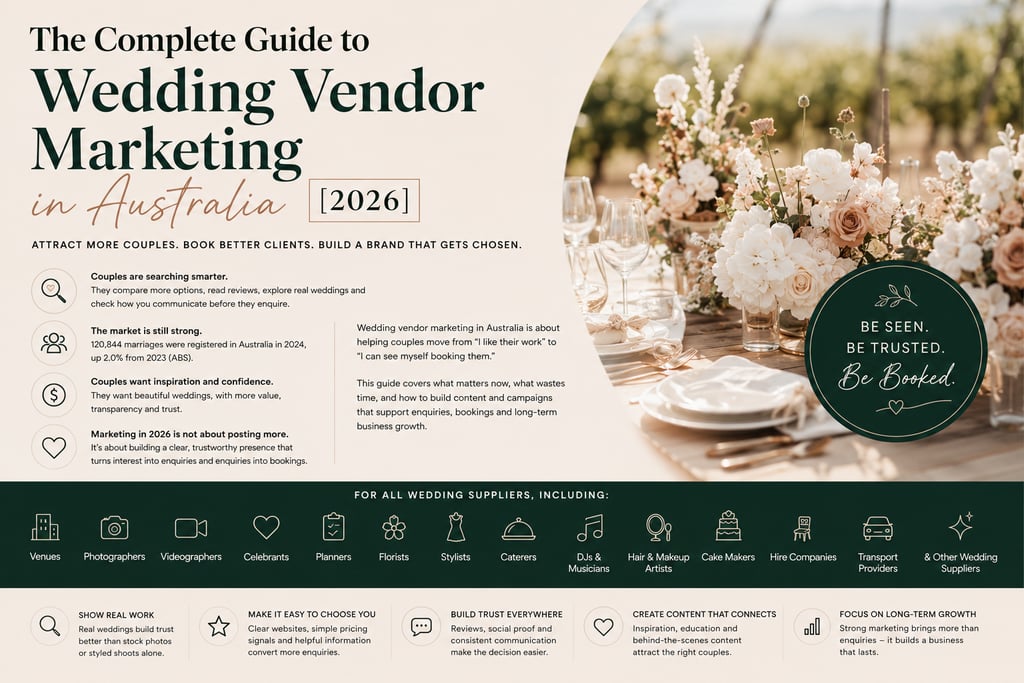
Wedding vendor marketing in Australia has changed, and not in ways that make it simpler. Couples are still getting married, still spending money, still searching for beautiful venues, photographers, florists, celebrants, stylists and planners. But the way they choose suppliers is more considered than it used to be. They are comparing more options, looking for proof, checking social media, Google reviews, websites, pricing signals, supplier tags, real wedding galleries and how you communicate before they ever make contact. They want inspiration, but they also want confidence. They want their wedding to feel personal, but they are increasingly careful about budget, value and trust.
The Australian Bureau of Statistics recorded 120,844 marriages in Australia in 2024, up 2.0% from 2023, which shows the market remains active even as couples become more selective. At the same time, recent Australian wedding reporting shows couples weighing cost-of-living pressures, smaller guest lists, registry weddings, cash gifts and more practical choices alongside traditional celebrations. That context matters for how you market, because the couple booking a 120-person winery wedding and the couple planning an intimate restaurant ceremony are making completely different decisions, and your marketing needs to meet them where they are rather than assuming everyone wants the same thing.
Strong wedding vendor marketing in 2026 is not about posting more for the sake of posting more. It is not about copying whatever is trending on TikTok this week. It is not about discounting every time enquiries slow down. It is about building a clear, trustworthy presence that helps couples move from “I like their work” to “I can see myself booking them” — and that shift requires more than beautiful photos.
What Wedding Vendor Marketing Really Needs to Cover:
Wedding vendor marketing is everything that helps engaged couples, planners, venues and other suppliers discover, understand, trust and book your business. It includes your website, Google Business Profile, SEO, social media, wedding directories, real wedding features, email responses, pricing guides, reviews, referrals, styled shoots, paid advertising, networking, blog content, brand voice and the way you handle every enquiry that comes in. For Australian wedding vendors, marketing is not one channel — it is an ecosystem, and every part of it either builds confidence or creates doubt.
A couple may first find you through Instagram, then Google your business name, then check your reviews, then visit your website, then look at your pricing, then ask their venue coordinator whether you are reliable, then send an enquiry, and then judge the quality of your reply. Every single step in that journey is part of your marketing, whether you have thought about it that way or not. The vendors who understand this tend to stop thinking about individual posts and start thinking about systems — because the goal is not to get attention once, it is to remove uncertainty consistently until the right couples feel ready to reach out.
Why Wedding Vendor Marketing Feels Harder in 2026:
Many wedding vendors feel like marketing has become harder even when their work is better than it has ever been, and there are real reasons for that. Couples now have more choice than any previous generation of engaged people — they can compare dozens of photographers, celebrants, florists or venues in a single evening, saving Instagram posts, browsing directories, reading reviews and asking Facebook groups for recommendations without leaving their couch. Attention is fragmented across Instagram, TikTok, Pinterest, Google, venue lists, directories, bridal expos, friend groups, planners and supplier tags, which means there is no single reliable path to a booking anymore.
The market is also more value-conscious, and that does not mean couples are only looking for the cheapest option — it means they are asking whether a supplier is worth it for them specifically, which requires your marketing to communicate value clearly rather than just beauty. Trust matters more too, because a wedding is a once-only event and couples need suppliers who are not just talented but reliable, responsive and experienced enough to handle whatever comes up on the day. And perhaps most importantly, generic marketing has stopped working in a category where “luxury,” “bespoke,” “timeless,” “romantic” and “unforgettable” appear on almost every supplier’s website. If your copy sounds like everyone else’s, couples may admire your work but not remember you long enough to enquire. In 2026, the vendors who consistently win bookings are usually not the ones doing everything — they are the ones doing the right things in a way that is specific enough to be believed.
The 2026 Wedding Marketing Reality in Australia:
Australian couples are not all behaving the same way, and treating them as though they are is one of the fastest ways to make your marketing feel irrelevant. Some couples are planning premium multi-day celebrations with large guest lists and significant budgets. Some are choosing small restaurant weddings with twelve people and spending heavily on photography and food. Some are prioritising guest experience over tradition. Some are cutting numbers and spending more on individual elements. Some are choosing registry ceremonies and saving for property, travel or family goals. The range of decisions is wide, and the emotional drivers behind each one are different.
Industry commentary from Easy Weddings points to a continued focus on personalised, human-centred celebrations in 2026, while its wedding industry reports track planning behaviours, pain points, spending influence and supplier category trends. Google’s own guidance reinforces that useful content should be created for people first, while making it easy for search engines to understand and surface it. For wedding vendors, that combination of insights translates into one practical question: what do couples in your specific market need to know before they feel confident booking you? The vendors who answer that question clearly and consistently in their marketing tend to attract better-fit enquiries, have easier sales conversations and build stronger reputations over time.
The Foundation: Positioning Before Promotion:
Before you invest time or money in ads, directories, SEO or content, you need clear positioning — and positioning is not just a marketing exercise, it is the answer to questions that shape everything else. Who are you for? What kinds of weddings do you suit? What do you want to be known for? Why should couples trust you over the many other options in your category?
A wedding photographer who specialises in candid, documentary-style celebrations should not market exactly like a photographer known for editorial, highly directed imagery. A florist known for sculptural installations should not sound like a florist offering simple seasonal bouquets for intimate weddings. A celebrant with a relaxed, funny, story-led style should not sound like a formal traditional celebrant. A venue built for luxury multi-day events should not speak like a casual winery that does beautifully relaxed long lunches. The clearer your positioning, the easier every other piece of your marketing becomes, because you finally know what to say, what to leave out and what kind of couple you are speaking to. A simple positioning formula can help: “We help [type of couple] create [type of wedding experience] with [your distinctive approach].” Once that sentence is clear, the rest of your marketing has something real to build from rather than defaulting to language that could belong to anyone.
What Couples Need From Your Marketing:
Couples are not just looking for inspiration when they research suppliers — they are looking for answers, and the answers they need change depending on where they are in the planning process. Early on, they may be asking what style they like, what a particular type of supplier does, how much they should budget, when to book, what questions to ask and what is realistic for their location or guest count. Further into the process, they are asking whether you are available, whether you suit their style, whether you have worked at their venue, whether you are within budget and how professional you seem. By the time they are close to enquiring, they are asking whether they can trust you, whether you are responsive, whether your quote is clear and whether you will deliver what you promise.
Your marketing should support this whole journey rather than only speaking to couples who are ready to book today. Many vendors make the mistake of creating content only for people who are already convinced, which means they miss the much larger group of couples who need repeated reassurance before they feel ready to reach out. A strong marketing system helps people build confidence over time — through useful blog posts early in the research phase, through real wedding galleries and testimonials in the comparison phase, and through a clear and warm enquiry process at the moment of decision. Every stage matters, and skipping any of them leaves gaps that your competitors will fill.
Your Website Is Still the Centre of Your Marketing:
Social media is important, but your website remains your main trust platform — and the distinction matters because they do different jobs. Instagram can show your style. TikTok can create reach. Pinterest can inspire. Directories can introduce you. But your website is where couples look for substance, and if it does not hold up under that scrutiny, all the attention you have built through other channels goes to waste.
A strong wedding vendor website should tell people who you are, what you offer, where you work, what kinds of weddings you specialise in, what your work looks like, what is included, how your process works, what past couples say and how to enquire. It should not be a digital brochure from five years ago — it should be an active trust and sales tool that makes it easy for the right couples to take the next step. Every vendor website needs a clear homepage, strong service pages, an about page, portfolio or gallery pages, testimonials, a FAQ section, location and service area information and obvious calls to action throughout. Google’s own guidance reinforces that search optimisation is about helping users understand your content and decide whether to visit, which in practical terms means writing clearly, structuring logically and building your pages around the questions couples are already asking. If someone cannot tell what you do, where you are and how to enquire within a few seconds of landing on your site, your website is losing leads that your marketing worked hard to bring in.
Service Pages Need to Work Much Harder:
Many wedding vendors have service pages that look polished but fail to do the actual job of converting interest into enquiries. Beautiful images, a few emotional sentences and a contact button may feel complete, but they often leave couples with unanswered questions that push them back to Google to keep comparing. A strong service page explains what the service is, who it suits, what is included, how the process works, where you are based, what the investment looks like, what past couples say about it and what the next step is.
Different vendor categories need different things on their service pages. A venue page should cover capacity, ceremony and reception options, wet-weather plans, food and beverage, inclusions, accommodation, accessibility, curfew, parking and preferred supplier information. A photography page should cover style, editing approach, full galleries, timeline guidance, delivery timeframes and what the experience feels like on the day. A videography page needs to explain film style, audio capture, speech recording, highlight versus full film options, drone availability and turnaround times. A celebrant page should explain legal requirements, ceremony writing, vow support, rehearsal options, tone and what happens before the wedding day. A florist page should address minimum spend, design process, seasonal flowers, installation, pack-down and venue access needs. A planning page needs to define full planning, partial planning and on-the-day coordination clearly enough that couples understand which one they actually need. A hair and makeup page should include bridal trials, group bookings, travel, timing, product quality and experience across different skin tones, hair textures and ages. An entertainment page should explain ceremony music, reception sets, MC options, equipment, song requests and how the dance floor gets managed. A vague page creates doubt. A useful page creates confidence, and confidence is what produces enquiries.
Google Business Profile: Essential for Local Wedding Enquiries:
For Australian wedding vendors, Google Business Profile is especially important because so many wedding searches are local and high-intent. People search for wedding photographers in Melbourne, wedding venues in the Hunter Valley, marriage celebrants in Brisbane, wedding florists in Adelaide and wedding makeup artists in Perth with the clear intention of booking someone. If your profile is incomplete, outdated or missing entirely, you are invisible to a significant portion of your potential market.
Google’s own guidance makes clear that local results are based on relevance, distance and prominence, and that there is no way to pay for better placement — which means the work of keeping your profile current and complete is genuinely what determines whether you show up. To make your profile work properly, choose accurate categories, add all relevant services, keep your business name and contact details consistent, add your service areas, upload fresh high-quality images, post occasional updates and actively ask happy clients for reviews. Reviews are a major trust signal in this category because they answer questions your own copy cannot — whether you were calm under pressure, whether you delivered what you promised, whether you were genuinely responsive, whether guests noticed the quality of your work. Ask for reviews soon after the wedding while the experience is still fresh, make it easy by sending a direct link with a warm and simple prompt, and respond to reviews professionally whether they are positive or constructive. A well-maintained Google profile feels like a business worth trusting. An abandoned one raises questions before the couple has even visited your website.
Reviews, Testimonials and Social Proof:
Wedding vendors sell trust before they sell a service, and a potential couple may love your portfolio while still needing reassurance that you can handle the pressure of a real wedding day with real people and real stakes. Good testimonials bridge that gap, and the difference between a weak one and a useful one is specificity. A testimonial that says “amazing supplier, highly recommend” gives the reader nothing to hold onto. A testimonial that says “we were nervous about being awkward in photos, but she made us feel completely relaxed and the images look natural and emotional rather than staged” tells a future couple exactly what problem was solved and how.
For venues, look for testimonials that mention how smoothly the day ran, how staff handled problems and how guests felt about the overall experience. For photographers, look for words about relaxed delivery, natural results and emotional moments captured. For planners and coordinators, look for mentions of problems solved quietly, timelines managed well and couples being able to stay present rather than managing logistics. For florists, look for testimonials that describe the visual transformation and whether the brief was truly understood. Place testimonials across your website near the service they relate to rather than burying them all on a single reviews page — a photography testimonial placed next to a full gallery does more work than the same review three pages deep. The ACCC also makes clear that businesses must avoid false or misleading claims including exaggerated testimonials, which matters here not just legally but because honest and specific social proof is genuinely more convincing than anything inflated or vague. Trust is not a marketing tactic — in wedding vendor businesses, it is the product itself.
Social Media: What Still Works for Wedding Vendors:
Social media is still valuable for wedding vendors, but only when it is used as part of a broader system rather than treated as the whole plan. The mistake many vendors make is putting all of their marketing energy into social media while their website is weak, their email list is quiet, their service pages are thin and their SEO is ignored. That approach places enormous pressure on individual posts to carry the entire sales function, which is not what social media is designed to do.
For wedding vendors, social content should be doing at least one of five things at any given time: showing your work in context, explaining your process, building trust through proof, educating couples about your category, or strengthening supplier relationships. Pretty images are useful but they need context to close the gap between “I like their work” and “I understand why I should book them.” A post that explains why you chose certain florals for a particular venue, or what made a ceremony work for a specific couple, or what the light is like in a particular location at a certain time of day — that kind of content teaches couples how to value your work, which is a much more durable form of marketing than posting a beautiful image with “still obsessed with this day” underneath it. Instagram should carry portfolio, brand feel, supplier tagging and behind-the-scenes content. TikTok can be useful for reach, education and personality especially for vendors who are comfortable on camera. Pinterest works more like a visual search engine than a social platform and is particularly valuable for florists, stylists, venues, photographers and cake makers. The goal is not to be everywhere — it is to use each platform for what it does best while keeping the website, email and referral relationships doing their jobs alongside it.
Content That Supports Enquiries and Bookings:
Content should not be random — it should support the path to enquiry, and that path looks different depending on where a couple is in the planning process. Discovery content helps couples find you early, through blog posts that answer planning questions, cost guides, location guides and explainers about what different supplier categories do. Trust content helps couples feel safe once they have found you, through real wedding case studies, behind-the-scenes process posts, testimonials, FAQ pages and supplier collaboration features. Conversion content helps couples take action, through package explanations, availability reminders, enquiry page copy, pricing guidance and consultation invitations. Referral content strengthens industry relationships, through venue features, supplier spotlights, styled shoot credits and collaborative posts that give other suppliers a reason to recommend you.
The best content answers the specific questions that block enquiries in your category. If couples constantly ask about pricing, create pricing guidance rather than expecting them to enquire blind. If they ask whether you travel, create a clear travel page. If they ask whether you have worked at a particular venue, publish venue-specific galleries. If they misunderstand what is included in your service, create a detailed process post. Content that reduces friction is worth far more than content that simply looks nice. The vendors who understand this tend to attract better-fit enquiries, have shorter sales conversations and convert a higher proportion of the leads they generate.
Blog Topics for Australian Wedding Vendors:
A useful blog strategy helps couples discover you before they are ready to book, and the topics that work best are the ones that match what people are searching for during the planning process. For venues, that might mean articles on how to choose a wedding venue in a specific location, questions to ask before booking, cocktail versus seated reception formats, wet-weather planning and what different seasons are like in different regions. For photographers, useful topics include how to choose a wedding photographer, the difference between documentary and editorial styles, how many hours of coverage you actually need, the best time of day for portraits and how to feel natural in wedding photos. For videographers, covering whether wedding video is worth it, what the difference between a highlight film and a full ceremony film looks like, and how audio capture works tends to be particularly useful because video is a category where couples often need education before they decide. For celebrants, how to choose a marriage celebrant, what a celebrant does, how to write personal vows and the legal requirements for getting married in Australia are all genuinely searched topics. For florists, a seasonal flower cost guide for Australian couples, how colour palettes get chosen and what affects the overall cost of wedding flowers are questions couples have before they ever contact a supplier. For planners, the difference between a wedding planner and a coordinator, whether on-the-day coordination is worth it and how to build a wedding run sheet are pieces that attract couples who are actively trying to understand what kind of help they need.
Every blog post should finish with a soft and natural invitation — not a hard sales push, but a clear indication that you are available to help with what the reader is planning. TOFU content works because it builds trust gradually, and a gentle call to action at the end of a genuinely helpful article is far more effective than pressure applied too early in the relationship.
Real Wedding Features: The Most Underrated Marketing Asset:
Real wedding features are among the most powerful content a wedding vendor can produce, and most vendors underuse them significantly. A single real wedding can become a website gallery, a blog post, multiple Instagram posts, several reels, Pinterest pins, a supplier collaboration post, a venue-specific SEO page, a testimonial feature, email newsletter content, a directory submission and a sales call example. That level of content output from one wedding is remarkable, and it is far more credible than anything created from scratch because it shows your work in genuine context rather than curated isolation.
A strong real wedding blog post should include the couple’s names if permitted, the venue and location, the wedding style, the supplier credits, the brief or vision behind the day, any special details or challenges, your specific role and contribution, a full gallery and a testimonial. The writing should give the reader a real picture of the day rather than defaulting to “a beautiful wedding at X venue.” A post that describes a relaxed Yarra Valley wedding built around long-table dining, soft seasonal florals and a ceremony that felt intimate despite 120 guests gives both search engines and couples far more to work with. Venue-specific real wedding features are particularly valuable for SEO because couples frequently search for suppliers who have worked at their venue — a photographer with a gallery called “Modern Wedding at Stones of the Yarra Valley” or a florist with “Seasonal Floral Styling at Gabbinbar Homestead” can capture highly relevant search traffic from couples who are already close to making a decision.
Supplier Trust: Marketing to Other Vendors:
Wedding vendor marketing is not only about reaching couples — it is also about earning trust from other suppliers, and for many businesses referrals from venues, planners, photographers, celebrants and florists become one of the most consistent sources of bookings over time. Suppliers recommend vendors who are reliable, calm under pressure, clear communicators, respectful on site, easy to work with, generous with credits and images, and professional with timelines. A planner will not recommend you because your Instagram looks polished. They recommend you because they trust you not to create problems on a day when problems are very difficult to fix.
Building supplier trust requires consistent and generous behaviour over time. Credit all vendors properly and promptly. Share galleries when permitted. Tag suppliers in posts and stories. Send thank-you messages after weddings. Create venue-specific content that gives venues a reason to share your work. Attend industry events. Refer work to others when you genuinely cannot take it. Be professional in every DM, comment and on-site interaction. Avoid public complaints about other suppliers regardless of how frustrating the situation may be. The reputation that comes from this kind of consistent professionalism compounds over time in a way that advertising simply cannot replicate — because a referral from a trusted supplier carries a weight that no amount of paid promotion can manufacture.
Wedding Directories: Worth It or a Waste of Time:
Wedding directories can work, but they are not the automatic bookings machine many vendors hope for when they first sign up. A directory listing can help with visibility, backlinks, reviews and discovery, but many vendors waste their investment by treating the listing as a set-and-forget exercise rather than an active marketing asset. To make a directory work, choose platforms that suit your category and location, use strong and current images, write copy that is specific to your positioning rather than generic, include your service area clearly, update the listing regularly, add reviews as they come in, respond quickly to enquiries that arrive through the directory and track leads separately so you can assess whether the cost per booking makes commercial sense.
The most important thing about your directory listing is the copy, because in a directory environment couples are comparing multiple suppliers side by side and generic language that might pass unnoticed on your own website becomes very obvious when it looks identical to every listing around it. Describing yourself as providing beautiful personalised wedding services tells the couple nothing they could not read on fifty other listings. Describing exactly what you do and who you do it best for gives a couple a reason to click on your listing rather than the one next to it. That specificity is what makes a directory listing worth paying for — not the listing itself, but the clarity of what you say inside it.
Paid Ads: When They Help and When They Waste Money:
Paid ads can be genuinely useful for wedding vendors, but only when the rest of the marketing system is already working. Google Ads can capture couples who are searching with clear intent — wedding venue Mornington Peninsula, wedding photographer Sydney, wedding florist Brisbane — because those searches indicate someone actively looking to book rather than passively browsing. Social ads can work for awareness, retargeting and promoting lead magnets, venue open days or seasonal campaigns. But ads waste money when the website they point to is unclear, the offer is vague, the enquiry form is clunky, the pricing is confusing, the photos do not match the market or the follow-up process is slow. Sending paid traffic to a homepage instead of a relevant landing page, failing to track where leads come from and running ads without conversion tracking in place are all common ways vendors spend money without understanding whether it is producing bookings.
Before running any paid campaign, make sure you have a strong landing page, clear calls to action, good reviews visible, strong visuals that reflect your positioning, conversion tracking in place and a follow-up process that responds quickly and warmly. Paid ads should amplify a system that is already working — not compensate for one that is not. A beautiful ad sending traffic to a weak product page is not a marketing strategy. It is an expensive way to confirm that the fundamentals need fixing first.
Pricing Transparency: How Much Should You Share:
Pricing is one of the biggest friction points in wedding enquiries, and the instinct to hide it entirely usually creates more problems than it solves. Some vendors worry that listing prices will scare people away, but complete silence about investment tends to create uncertainty that pushes couples toward suppliers who are more upfront. The goal is not to publish a full price list if your work is genuinely custom — it is to give couples enough information to self-qualify before they reach out, which saves both parties time and produces better-fit enquiries.
Options include full package pricing, starting prices, average investment ranges, guidance around what most couples invest, a downloadable pricing guide, or a minimum spend disclosed alongside an invitation to enquire for a custom proposal. For many wedding vendors, a starting price or average range is the most practical middle ground. Something like “wedding photography collections begin at $4,200, with most couples investing between $5,000 and $7,500 depending on coverage and albums” gives a couple enough to know whether you are in their range without locking you into a fixed structure for genuinely complex or variable work. If you prefer not to publish full pricing, explain why in a way that is useful rather than evasive. “Because every wedding is different, I create custom floral proposals based on your venue, season, guest count and design priorities — my minimum spend for full-service weddings is $X” is honest and informative. “Contact us for pricing” on its own is not.
What Wastes Time in Wedding Vendor Marketing:
Not all marketing effort is equally useful, and one of the most valuable things a wedding vendor can do is identify where time and money are being spent without producing results. Posting daily without a clear purpose creates activity rather than momentum — a post should educate, inspire, prove, connect or convert, and if it is not doing any of those things it is filling a calendar without filling an enquiry inbox. Chasing every trend creates the same problem, because a luxury venue does not need to jump on every meme and a serious planner does not need to dance on TikTok if it undermines the positioning they have built. Obsessing over follower count is a version of the same mistake — a vendor with two thousand engaged local followers who regularly enquire is in a far better position than one with fifty thousand irrelevant followers who never convert into bookings.
Discounting too quickly in response to a slow period often does more long-term damage than short-term good, because it trains couples to wait for deals and can erode the positioning that justifies your pricing in the first place. If bookings slow down, the better first step is reviewing your messaging, visibility, website, reviews and follow-up process before reaching for a discount. Copying competitors’ language and content style is another common time-waster, because their marketing may not even be working, and copying it only makes you less distinctive in a category where standing out is everything. And ignoring the enquiry follow-up after all the work of generating interest is perhaps the most costly mistake of all — many vendors lose bookings not because their work is not good enough, but because their response to the enquiry was slow, generic or unclear at the moment it mattered most.
The Enquiry Experience Is Marketing:
A couple’s first enquiry is one of the most important trust moments in the entire sales process, and most vendors do not treat it that way. If a couple receives a warm, clear and genuinely helpful reply quickly, their confidence increases significantly. If they receive a slow response, a vague template or an automated reply that does not acknowledge anything specific about what they shared, doubt enters — and doubt is very hard to recover from in a category where couples are comparing multiple suppliers at the same time.
A strong enquiry reply should include a warm greeting, a genuine acknowledgement of their wedding and what they shared about it, confirmation that you received their details, your availability status, the next steps clearly explained, pricing guidance or a package overview if appropriate, a consultation call link if that is your process and a friendly and professional sign-off. An email that says “your Byron Bay wedding at The Orchard Estate sounds beautiful, especially the relaxed long-lunch feel you described — I am available for your date and would love to talk through what you are planning” does something that a template cannot: it shows the couple that you read what they sent and that you are already thinking about their specific day. That response is marketing. It communicates professionalism, warmth and attentiveness at the exact moment those qualities are being evaluated, and it is completely within your control.
SEO for Wedding Vendors in Australia:
SEO can be one of the strongest long-term marketing channels for wedding vendors because wedding searches are often local and high-intent — people searching for a wedding photographer in Sydney or a wedding venue in the Hunter Valley are not browsing casually, they are actively trying to make a decision. The vendors who show up clearly in those searches have a significant advantage over vendors who rely entirely on social media or word-of-mouth referrals, because organic search traffic tends to be warmer, more consistent and far less expensive over time than paid alternatives.
Important SEO targets include service plus location keywords, venue-specific keywords, planning question keywords, cost-related keywords, style keywords and supplier comparison keywords. Your SEO strategy should include strong service pages, location pages where appropriate, venue-specific real wedding posts, helpful blog content, well-named images, internal links between related pages, clear headings, fast mobile performance and Google Business Profile alignment. Do not approach SEO by stuffing keywords into copy — write useful, specific content that naturally includes the phrases couples use when they are looking for what you offer. A good SEO page helps the reader first and the algorithm second, because Google’s own guidance makes clear that useful people-first content is what it is designed to surface. The vendors who write genuinely helpful pages that answer real questions tend to outrank vendors who optimise aggressively but say very little of substance.
Local SEO: Own Your Region:
Most wedding vendors do not need to rank nationally — they need to rank in the specific regions where they actually book work, and that distinction shapes the entire approach. A Southern Highlands wedding florist, a Mornington Peninsula wedding photographer, a Hunter Valley wedding venue and a Gold Coast wedding celebrant all have different local SEO needs, and the work of building that regional visibility is more specific than general SEO advice tends to acknowledge.
Local SEO works best when your website and Google profile clearly show your service areas and the specific locations where you have done real work. Include your main city or region, nearby areas you serve, venue names where you have worked, local testimonials, real wedding galleries organised by region and travel information for couples considering you from further away. Avoid creating dozens of thin suburb pages with nearly identical copied content — that approach does not add value for readers or search engines and can actively harm your rankings over time. Instead, create genuinely useful regional pages. A page called “Wedding Photography in the Southern Highlands” could include your approach to photographing that region, the best seasons and light conditions, the venues you have worked at, full galleries from real weddings there, travel details and testimonials from local couples. That is useful. A page that swaps one suburb name for another while keeping everything else identical is not.
Brand Voice: How to Stop Sounding Generic:
Wedding marketing is full of overused language, and the problem is not that individual words are wrong — it is that they have appeared on so many supplier websites that they have stopped meaning anything. Your dream day. Unforgettable memories. Timeless elegance. Bespoke experience. Picture-perfect. Stress-free wedding. Making magic. Love story. Special day. Unique celebration. If your marketing relies heavily on phrases like these, it may look polished but it blends into a category where almost everyone sounds exactly the same.
Better wedding vendor copy is specific enough to be believed. Instead of writing that you create unforgettable wedding florals, you could describe designing seasonal florals with movement, texture and a sense of place so that the flowers feel connected to the venue rather than copied from a mood board. Instead of writing that you capture timeless memories, you could describe photographing the quiet looks, loud dance floor moments and family chaos that couples may not notice on the day but will want to remember later. Instead of writing that you make the wedding planning stress-free, you could describe managing the supplier emails, timeline details and on-the-day decisions so that the couple can be present with their guests instead of checking their phone. Specificity makes copy believable, and believable copy is what produces enquiries rather than polite appreciation. A useful approach for wedding vendors is writing the way a trusted friend with professional expertise would speak — approachable and warm, but clearly confident in what they know and what they can do.
What to Say on Your Homepage:
Your homepage should quickly answer what you do, who you do it for, where you work and what makes your approach different — and it should answer those questions in the first few seconds rather than making people scroll to find them. A strong homepage structure moves through a hero section with a clear positioning statement, a service overview, a portfolio or featured work section, a process summary, testimonials, an about preview, featured real weddings or blog posts and a clear enquiry call to action. The homepage should not try to say everything — its job is to guide visitors to the next best page and give them enough confidence to keep exploring.
For a photographer, a homepage hero might read: “Natural wedding photography for couples who want the day to feel like themselves — documentary-style photography across Melbourne, the Yarra Valley and regional Victoria, capturing real emotion, honest moments and the people who matter most.” For a florist: “Seasonal wedding flowers with movement, texture and meaning — floral design for modern Australian weddings, from intimate restaurant celebrations to full-scale venue installations.” For a planner: “Wedding planning for couples who want calm, clarity and a beautifully run day — full planning, partial planning and on-the-day coordination for private estate, marquee and venue weddings across New South Wales.” Each of those examples is specific enough to tell the right couple immediately that they are in the right place, which is exactly what a homepage hero needs to do.
Trust Signals Every Wedding Vendor Needs:
Trust signals help couples feel safe enough to enquire, and for higher-priced services they are not optional — they are what justifies the investment before a couple has met you. Important trust signals include reviews, specific testimonials, real wedding galleries that show genuine work rather than only styled shoots, professional photography throughout the website, supplier credits that show industry relationships, venue experience, relevant awards or memberships, clear pricing guidance, a visible and explained process, published FAQs, media features where relevant, years of experience, the number of weddings completed if it is accurate and meaningful, insurance or licensing where relevant to the category, response time expectations, a professional email address and an updated website and social presence that shows the business is active.
The accumulation of these signals is what builds the kind of trust that makes a couple feel confident committing to a supplier they have never met. A vendor with beautiful work but a website that feels unfinished, no visible reviews, vague service descriptions and unclear pricing is asking couples to take a leap of faith that most of them are not willing to take when there are alternatives who have done the work of building confidence properly.
Marketing for Different Wedding Vendor Categories:
Every vendor category has a different primary buying question, and understanding that question is what makes category-specific marketing work rather than generic supplier marketing.
Venues should prioritise marketing the experience and the logistics together, because couples need to both imagine the wedding and understand whether the practical details work for their guest count, budget and vision. The most useful venue marketing covers location, capacity, wet-weather options, food and beverage, ceremony and reception spaces, photo locations, accommodation, packages, open day invitations, real weddings showing the space in different configurations and virtual or video tours for couples who cannot visit in person before deciding.
Photographers should prioritise marketing style, trust and the experience of being photographed, because couples need to know both how you see a day and how you make people feel in front of a camera. Full galleries rather than only curated highlights, an honest explanation of your editing approach, testimonials that mention feeling relaxed and natural, timeline guidance and clear delivery information are all things that help couples feel confident rather than just impressed.
Videographers need to explain value more actively than most other categories because some couples still see wedding video as optional rather than essential. Marketing that focuses on emotional storytelling, the irreplaceable quality of audio from vows and speeches, real film examples that show the full range of what a wedding film captures, and an honest explanation of what is included in different packages tends to be more effective than marketing that only shows cinematic highlight footage.
Celebrants should market voice, tone and the ceremony experience rather than leading with legal credentials, because couples are primarily asking whether you can make the ceremony feel like them. Videos of ceremony delivery where appropriate, testimonials that describe the tone and emotional landing of the ceremony, a clear explanation of how you approach script writing and vow support, and copy that gives couples a genuine sense of what working with you will feel like are all more useful than a generic list of what is included.
Florists and stylists should market visual transformation and process together, because couples need to understand both what the finished result could look like and what it takes to get there. Minimum spend information, design consultation process, mood board development, installation capability, seasonal expertise, venue familiarity and pack-down and logistics are all things couples need to understand before they commit to a florist for a significant investment.
Planners and coordinators must market clarity, calm and problem-solving rather than only aesthetic results, because couples are choosing them to manage complexity and reduce risk. The scope of service, the difference between full planning and on-the-day coordination, the process of supplier management, timeline creation and budget guidance, case studies that show how problems were handled and testimonials that specifically mention the couple’s ability to be present on the day are all more useful than beautiful styled shoot imagery alone.
Hair and makeup artists should market reliability, skill across different looks and the comfort of the wedding morning experience, because couples are trusting them with how they look on one of the most photographed days of their lives. Experience across different skin tones, hair textures and ages, bridal trial information, wedding morning timing expertise, group size capability and travel logistics are all practical considerations that couples need answered before booking.
Bands, DJs and musicians should market atmosphere and professionalism together, because couples need to believe that the entertainment will create the dance floor energy they are imagining and handle the professional requirements of a live event without issues. Live performance clips, ceremony and reception package clarity, MC capability, equipment information, song selection process, experience reading a room and reviews that specifically mention the dance floor are all things that convert interest into bookings in this category.
Influencers, Styled Shoots and Collaborations:
Collaborations can be useful, but they need strategy rather than just enthusiasm. Styled shoots can help build portfolio content, connect with suppliers, test creative ideas, generate publication opportunities, show a new market or style and create social and Pinterest assets. But they waste significant time when there is no distribution plan attached to them. Before participating in a styled shoot, it is worth asking what the concept is and whether it suits your target client, who is involved, who is submitting it for publication, whether all suppliers will receive images and on what timeline, whether credits are agreed in advance and whether you can use the content commercially across your website, Pinterest and social media.
Influencer collaborations require transparency about the commercial arrangement. The ACCC has highlighted concerns around misleading influencer endorsements and has encouraged businesses and influencers to review their practices to make sure consumers are not misled about whether content is paid, gifted or commercially arranged. For wedding vendors, authenticity matters in a particularly direct way — couples can sense when a collaboration is misaligned or when the endorsement does not feel genuine, and that misalignment can undermine trust at exactly the moment you are trying to build it.
Email Marketing for Wedding Vendors:
Email is underrated in wedding marketing, partly because the booking cycle is long and event-based rather than transactional. But not every couple enquires the first time they visit your website — some download a guide, attend an open day, ask for pricing or follow your social media for months before they are ready to make contact. Email gives you a way to stay in front of those couples during that consideration period without relying on an algorithm to show them your content.
Useful email approaches for wedding vendors include planning checklists offered as lead magnets, seasonal wedding guides, pricing guides that couples can download before enquiring, venue brochures, real wedding features sent to a subscriber list, open day invitations, availability updates for popular dates, timeline guides and FAQ content that answers common questions across different planning stages. For a photographer, a lead magnet might be a wedding photography timeline guide. For a florist, a seasonal wedding flower guide for Australian couples. For a venue, a wedding packages and private tour guide. For a planner, a twelve-month wedding planning checklist. Email should be helpful rather than promotional in tone — send value, tell stories, answer real questions and invite action when the timing is natural. Couples who have chosen to hear from you are far warmer than any paid audience, and treating that relationship accordingly tends to produce better enquiries over time.
The Role of Content Planning in Wedding Vendor Marketing:
A content funnel helps couples move from awareness to booking through a series of touchpoints rather than a single moment of discovery. At the top of the funnel, education and inspiration content helps couples find and understand you — blog posts, Pinterest pins, Instagram reels, planning checklists, cost guides and trend commentary all serve this purpose. In the middle of the funnel, trust and consideration content helps couples compare and feel safe with you — real weddings, testimonials, behind-the-scenes posts, process explanations, FAQ content, package overviews and venue-specific galleries all do this work. At the bottom of the funnel, enquiry and booking content helps couples take action — pricing guides, availability posts, consultation invitations, clear enquiry pages and follow-up email sequences complete the journey.
A good content plan means you are not relying on one viral post or one directory listing to do everything. You are building a pathway that meets different couples at different stages of readiness, answers their questions at each stage and consistently moves them closer to the point where reaching out feels like the obvious next step. Repeat this structure across different service types, different seasons and different audience segments and you have a marketing system rather than a series of individual efforts.
How to Measure Wedding Marketing Success:
Marketing should be measured by business outcomes rather than platform metrics, and the vendors who track the right things tend to make significantly better decisions about where to invest their time and money. Website traffic, organic search enquiries, Google Business Profile calls and clicks, directory enquiries, social media enquiries, email list growth and enquiry-to-booking conversion rate are all worth tracking regularly. Average booking value, cost per lead, cost per booking, referral sources, most profitable channels, most common objections and the time from first enquiry to signed contract are all things that tell you how the system is actually performing rather than how it looks from the outside.
Asking every enquiry how they found you — with clear options like Google, Instagram, TikTok, Pinterest, venue recommendation, planner recommendation, friend or family referral, directory, wedding expo or other supplier — and reviewing those responses monthly or quarterly often reveals surprising patterns. You may discover that Instagram gets a lot of attention but Google produces most of the bookings. Or that directories bring volume but supplier referrals bring better-fit clients. Or that blog posts attract couples much earlier in the research process and email then nurtures them into enquiries months later. Data helps you stop guessing about what is working and start investing where the evidence is clearest.
A Simple 90-Day Marketing Plan for Wedding Vendors:
If you are not sure where to begin, start with a structured plan that strengthens the foundations before building anything more complex. In the first two weeks, clarify your positioning, define your ideal couple, review your website, check your Google Business Profile, audit your service pages, review your enquiry process, identify your strongest reviews and list your top referral partners. In weeks three and four, fix the most important gaps — rewrite your homepage hero, improve one key service page, update your Google Business Profile with current photos, request reviews from recent happy clients, refresh your enquiry email template and make your calls to action clearer throughout the site.
In the following month, build content assets that will keep working over time — publish one helpful blog post, publish one real wedding feature, create social posts from that real wedding, add Pinterest pins if your category is visual, create one educational reel and add internal links between related pages on your website. In the final month of the 90-day plan, focus on distribution and relationships — reach out to five suppliers, send galleries or credits from past weddings, submit a real wedding to a directory or publication, test one small paid campaign if the foundations are solid, review your enquiry sources to understand what is working and plan your content approach for the following quarter. This plan is not glamorous but it works because it addresses the things that actually produce bookings rather than the things that produce the appearance of marketing activity.
What Matters Most in 2026:
The most effective wedding vendor marketing in Australia in 2026 is built around clarity, trust and usefulness rather than volume, trends or aesthetics alone. Clear positioning matters more than posting frequency. Strong website pages matter more than Instagram follower count. Local SEO and Google Business Profile maintenance matter more than styled shoot participation. Specific reviews and real wedding galleries matter more than perfectly curated feeds. Fast, warm and personalised enquiry responses matter more than elaborate automated sequences. Pricing clarity matters more than pricing secrecy. And consistent, useful content that answers real questions matters more than reactive posting that fills a calendar without supporting a booking.
What matters less is posting every day with no clear strategy, chasing every trend regardless of whether it suits your brand, copying competitors whose marketing may not even be working, obsessing over vanity metrics that do not translate into revenue, using generic luxury language that sounds identical to every other supplier in your category, hiding practical information that couples need before they feel ready to enquire, running ads before fixing the website they point to, investing in styled shoots with no distribution plan attached and discounting as a first response to slow enquiry periods rather than as a strategic choice.
Wedding couples want beauty, but they also want confidence — and the vendors who consistently provide both in their marketing are the ones who attract the right enquiries, convert them efficiently and build reputations that sustain them through market changes.
Work With No Worries Digital:
No Worries Digital works with Australian wedding vendors who are tired of posting without a plan and ready to build marketing that connects directly to enquiries, bookings and long-term supplier trust. We help venues, photographers, videographers, celebrants, planners, florists, stylists, caterers, entertainment suppliers and other wedding businesses build clear marketing systems across website copy, service pages, social media strategy, campaign planning, blog writing, Google Business Profile work, email content and the brand voice your business needs to earn trust before a couple ever reaches out.
We understand that a venue marketing the logistics and atmosphere of a full-day event is doing a completely different job than a celebrant marketing the tone of a thirty-minute ceremony, or a florist marketing a visual transformation that most clients cannot fully picture until they see it. That category understanding shapes everything we write, because wedding vendor marketing cannot be one-size-fits-all and still produce results. Every supplier category has different buying questions, different hesitations and different trust signals that matter most, and the copy and strategy need to reflect that rather than flatten everything into the same general tone.
If your website is not bringing in the right enquiries, if your service pages feel too thin or too generic, if your social media is active but not supporting the business properly, or if you know your marketing does not yet reflect how good your work is, the fix usually starts with getting the strategy and the words right. Once the buying decision is clear and the right things are being said in the right places, the rest stops feeling like random posting and starts behaving like part of the business.