
Pinterest for Wedding Suppliers: Why It’s Still the Strongest Platform
Learn how Pinterest for wedding vendors supports long-term visibility, inspiration-led browsing, website traffic and enquiries from couples planning ahead.
Karolina Kochanska
6/10/202639 min read
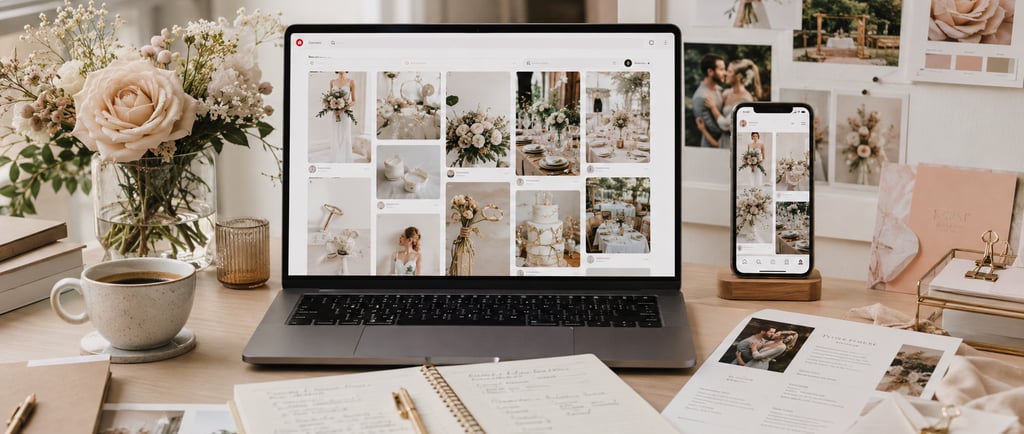
Pinterest is often misunderstood by wedding vendors.
And not in a small way. It is misunderstood at the most fundamental level — the level of what the platform actually is and what it is actually doing when couples open it on their phones at nine o’clock on a Tuesday night, glass of wine in hand, wedding board already three hundred pins deep.
Most wedding vendors treat Pinterest like another social media platform. Something to post on after Instagram. Another place to upload pretty images. Another channel to keep “active” when the marketing to-do list starts to feel overwhelming and scattered. They upload a few gallery images, write a vague caption, save it to a board called “Beautiful Weddings,” and wonder why nothing much seems to happen.
But Pinterest does not work like Instagram. It does not work like TikTok, Facebook or LinkedIn. It does not reward recency, personality, or the kind of consistent daily presence that other platforms demand. And if you approach it the same way you approach those platforms, you will consistently underestimate it — and consistently miss the very specific and commercially significant opportunity it represents for wedding suppliers.
Pinterest is a search and discovery platform. That is not a minor distinction. That is the entire thing. Couples do not go to Pinterest to check what you had for lunch or see whether you posted something this week. They go there to plan. To search. To collect ideas with intention. To compare styles and aesthetics over time. To build the visual vocabulary for a wedding they may not be booking suppliers for yet — but absolutely will be. And they do all of that searching, saving and comparing before they have made a single enquiry. Before they have even settled on a style. Before they know exactly what they want.
For wedding vendors, that makes Pinterest extraordinarily powerful. Not because it creates instant enquiries every time you pin something. Not because it replaces Instagram or makes the rest of your marketing strategy redundant. And certainly not because every supplier needs to become a Pinterest influencer with a million monthly views. Pinterest is powerful because it supports long-term visibility at the exact stage in the planning journey where couples are forming the preferences that will eventually shape every supplier decision they make.
If Instagram helps couples validate you after they have already found you, Pinterest can help them discover you earlier — long before they are ready to fill out your enquiry form. That earlier touchpoint matters enormously in an industry where trust, style alignment and brand recognition are often the deciding factors in who gets the booking. And that is why Pinterest for wedding suppliers is still, in 2026, one of the strongest platforms in the industry for vendors who want to be found by couples planning ahead.
Pinterest Is Not Social Media in the Usual Sense
To really understand why Pinterest works the way it does for wedding vendors, you need to understand the most important structural difference between Pinterest and every other platform you are probably using.
Most social platforms reward recency. You post today. The algorithm gives it a burst of attention — showing it to a portion of your followers, surfacing it in feeds, potentially boosting it if engagement is strong in the first few hours. Then it fades. By tomorrow, it is essentially gone. By next week, it might as well not exist. That model works reasonably well for certain things — announcements, behind-the-scenes moments, real-time event coverage, availability updates, vendor networking and relationship-building with your existing audience. But it also creates relentless pressure. If you stop posting consistently, your visibility on those platforms drops quickly and noticeably. The platform gives you attention in direct proportion to the attention you give it. The moment you step back, so does the reach.
Pinterest behaves fundamentally differently. On Pinterest, a well-crafted pin can continue appearing in search results, related pin feeds and boards months or even years after it was originally published. Couples searching for “modern garden wedding ceremony styling” in October might find and save a pin you published in February. A couple planning a 2027 wedding might save your work to their board in 2026 while they are still in the early stages of dreaming. That is not how any other platform in the wedding vendor toolkit works, and it is the single most important thing to understand about why Pinterest deserves a different strategic approach.
This makes Pinterest significantly closer to visual SEO than to traditional social media. It is a search engine with a beautiful interface, not a social feed with a search function bolted on. And for wedding vendors, that distinction carries enormous commercial weight, because wedding planning is not usually a one-day or one-week decision. Couples research venues, photographers, florists, stylists, celebrants, stationery designers, cake makers, hair and makeup artists, ceremony musicians, honeymoon destinations, and a hundred other things over a planning period that often spans six months to two years. Pinterest fits that slower, more deliberate journey in a way that no other platform does. It meets couples where they actually are — in the long, exploratory, ideas-rich middle phase of planning — and it keeps meeting them there every time they come back to search and save.
Couples Use Pinterest Before They Know Exactly What They Want
Here is something that is worth sitting with for a moment, because it is the insight that changes everything about how you approach Pinterest as a wedding vendor: most couples do not begin wedding planning with a fixed style brief, a clear supplier shortlist, or even a concrete idea of what they want their wedding to feel like. They begin with feelings and fragments.
They know they want something that feels romantic without being stuffy. Something outdoors but still elevated. Something personal rather than traditional. Something colourful, or something restrained. Something intimate, or something celebratory. They have impressions rather than decisions. They have aesthetic instincts without the vocabulary to describe them yet. And so they go to Pinterest to develop that vocabulary — to find the images that feel right, save them, look at them again, compare them to other images, and gradually build a picture of the wedding that lives in their imagination.
Those early searches look something like this: “garden wedding,” “modern romantic ceremony,” “European-inspired reception,” “editorial bridal look,” “intimate restaurant wedding,” “colourful wedding flowers,” “minimalist wedding invitations,” “black tie wedding styling,” “beach ceremony ideas,” “civil ceremony readings.” These are not purchase-ready searches. They are not the same as typing “Sydney wedding florist” into Google with credit card in hand. But they are deeply meaningful searches for wedding vendors, because they represent couples in the process of forming the preferences that will eventually determine which suppliers feel right for them and which suppliers feel wrong.
Pinterest’s own 2026 Wedding Trends Report describes wedding inspiration as beginning long before the aisle, with couples leaning into more personal, experience-led planning and deeply individualised celebration rituals. The report highlights a significant shift toward weddings that feel less like a formula and more like an extension of who the couple actually is — which means couples are spending more time in the discovery phase, not less, because they are trying to articulate something personal rather than simply replicate a template. For vendors, that shift extends the window of opportunity. Couples are on Pinterest longer, searching more broadly, and saving more intentionally than ever before. That gives you more opportunities to appear, to resonate, and to become part of the visual world they are building around their wedding — long before they are ready to send a single enquiry.
Pinterest Captures High-Intent Inspiration
There is a meaningful difference between passive scrolling and active planning, and it is a difference that matters enormously for your marketing strategy as a wedding vendor.
Someone watching random videos on TikTok or scrolling through an Instagram explore feed may encounter wedding content, enjoy it briefly, and keep moving. They are in entertainment mode. There is no planning intent behind the behaviour. They are not building anything, researching anything, or preparing to make any decisions. They are simply consuming content the algorithm served them, and they may have no upcoming wedding at all.
Someone who opens Pinterest and searches “modern wedding ceremony styling,” “Sydney garden wedding flowers,” or “wedding welcome sign ideas” is doing something categorically different. They are in planning mode. They are building a decision, deliberately and intentionally, one saved pin at a time. That search behaviour has intent behind it even when it does not yet have urgency — and intent is what separates a meaningful marketing touchpoint from background noise.
Pinterest’s scale in this space is significant. The platform facilitates more than 3.8 billion wedding-related searches every year according to Social Media Today, and more recent data from 2025 suggests that number has grown to over 7 billion wedding-related searches annually, with over 16.7 billion wedding ideas saved globally. Those numbers represent an enormous amount of active, intentional planning behaviour happening on one platform — and they give Pinterest a view into couple preferences, emerging trends, and planning patterns that no other platform can match.
That does not mean every search translates into an immediate enquiry. It does not work that way, and expecting it to will lead to frustration. But it does mean that Pinterest is full of planning behaviour, not entertainment behaviour — and for wedding suppliers, that distinction is everything. A couple may not be ready to email a florist today. But if they save your ceremony arch, your bridal bouquet or your tablescape to their wedding board, your work has entered their planning ecosystem. It is now part of the visual world they are building. It is a reference point they will come back to. It is a name they may remember when they are eventually ready to enquire. That is a meaningful and commercially valuable marketing touchpoint, even when it does not produce an immediate measurable outcome.
Pinterest Supports Long-Term Visibility
One of Pinterest’s biggest and most underappreciated advantages for wedding vendors is the lifespan of content on the platform. This is where Pinterest most dramatically diverges from every other social media platform in your toolkit, and where the strategic opportunity for suppliers who think long-term becomes clearest.
On Instagram or TikTok, content needs to perform quickly or it effectively disappears. The algorithm prioritises recent, high-engagement content, which means a post that does not get traction in the first few hours is unlikely to find significant reach later. That creates a specific kind of marketing pressure — the pressure to constantly produce new content just to maintain baseline visibility. It is exhausting, and it is the reason so many wedding vendors feel like they are constantly feeding a machine that never stays full.
Pinterest operates on a completely different logic. On Pinterest, search relevance matters far more than recency. A pin that is clearly titled, keyword-rich, visually strong, and linked to a useful destination can continue appearing in search results and related pins for months or years after it is first published. A photographer who pinned a gallery from a spring garden wedding in 2024 may still be receiving saves and website traffic from that pin in 2026, because couples searching “romantic garden wedding photography” are still finding it, still saving it, still clicking through. That is a return on content investment that simply does not exist on any other platform.
For wedding vendors, this longevity is especially significant because the wedding planning timeline is long and irregular. A couple who saves your ceremony florals in January may not be ready to contact a florist until September. A couple collecting ceremony inspiration may not reach out to a celebrant until they have confirmed their venue and date. A couple saving dress inspiration may not visit a boutique for six months. Pinterest’s content stays relevant across that entire extended timeline — and more importantly, it keeps working without requiring you to republish the same content repeatedly. Instead of asking “how many likes did this get today?”, the right question for Pinterest is: can this pin be discovered in search? Does it link to something useful? Would a couple save this for later? Does it show my style clearly enough to help someone decide whether I am the right supplier for their wedding? Does it connect to a service I actually want to book more of? Those are the questions that build long-term Pinterest value, and they are entirely different from the questions that drive Instagram strategy.
Pinterest Helps Vendors Shape Demand Before the Enquiry
Here is a dimension of Pinterest’s value for wedding vendors that rarely gets discussed but is arguably the most strategically significant: Pinterest is not only a platform for capturing existing demand. It is a platform for shaping preference — for influencing what couples want before they know they want it.
Consider this. A couple may not know they want colourful, expressive florals until they have seen enough images of them. They may not understand the difference between a formal, structured ceremony and a relaxed, story-led ceremony until a celebrant explains it visually through the kind of content that lives on Pinterest. They may not know what “editorial documentary wedding photography” looks like or feels like until they have spent time comparing it with more traditional portrait-style photography in their saved boards. They may not realise they want a low, lush centrepiece instead of a tall, formal arrangement until a florist’s pin shows them both and the difference becomes obvious.
Pinterest gives vendors the opportunity to educate visually at scale, before the enquiry, without the couple even being aware they are being educated. A florist who consistently pins seasonal palette inspiration, different bouquet shapes, and the relationship between ceremony flowers and reception styling is not just attracting couples who already know what they want — they are actively influencing what the next generation of couples will want, because they are shaping the visual reference points those couples are collecting. A celebrant who creates pins around ceremony structure, vow inspiration, and the emotional texture of different ceremony styles is not just being helpful — they are positioning themselves as the authority their ideal couples will naturally think of when they are ready to make decisions.
This preference-shaping function is where Pinterest becomes genuinely powerful as a marketing channel, rather than simply a visibility channel. It moves you from reactive to proactive. From waiting to be found to actively building the taste that makes couples want to find you. A florist can show seasonal palettes and demonstrate why certain flowers work in certain seasons. A stylist can show the transformation from an empty venue to a fully realised reception setup. A celebrant can share ceremony wording inspiration, vow ideas and relaxed ceremony concepts that help couples understand what a personal ceremony actually feels like. A photographer can show the same venue captured in different lighting conditions, helping couples understand why timing and style matter. A cake maker can show shapes, textures, serving sizes and design styles in ways that help couples make more confident decisions. A planner can share timelines, layout diagrams and design direction that demystify the planning process and make the value of a planner feel obvious.
This is where Pinterest transcends being a portfolio platform and becomes a genuine preference-building channel — one that serves your business at a strategic level far beyond its immediate measurable traffic and conversion metrics.
It Works Especially Well for Visual and Planning-Heavy Categories
Pinterest can add meaningful value for almost any wedding vendor, but it is particularly powerful for suppliers whose work is either highly visual, inherently searchable, or planning-heavy in nature. Understanding which category you fall into — and possibly into more than one — helps you develop a Pinterest strategy that plays to the platform’s genuine strengths rather than trying to force a fit that does not quite work.
For venues, photographers, videographers, florists, stylists, wedding planners, stationery designers, cake makers, dress designers and bridal boutiques, hair and makeup artists, and honeymoon or destination wedding brands, the visual case for Pinterest is obvious. Their work photographs beautifully, their content is naturally searchable by style and location, and couples are actively looking for exactly what they produce on a platform built for exactly that kind of discovery. The opportunity is large and the barrier to entry is relatively low.
For service-based vendors like celebrants, however, the opportunity requires a slightly different approach — and it is one that many celebrants in particular underestimate or overlook entirely. A celebrant may not have the same volume of spectacular visual content as a florist or a photographer, but they have something equally valuable on Pinterest: expertise that translates into planning content. A celebrant can create consistently high-performing pins around modern ceremony ideas, wedding vow examples, civil ceremony structure, personal wedding ceremony tips, how to choose a celebrant, legal wedding ceremony checklists, and readings for modern couples. This kind of content is searched for by couples at a very specific and high-intent stage of planning — the stage where they are actively figuring out what they want their ceremony to feel like. A celebrant who shows up clearly and helpfully at that stage has positioned themselves before the comparison shopping begins.
The key question for any vendor deciding how to approach Pinterest is not whether your service is “Pinterest-worthy” in a purely visual sense. It is whether your content — whatever form it takes — genuinely helps couples plan. If the answer is yes, there is a Pinterest strategy worth building.
Pinterest Is a Search Platform, So Keywords Matter
Pinterest content needs to be beautiful, but beauty alone does not make it findable. And findability is the entire point. A stunning image that no couple can ever discover because it has no searchable context is a wasted opportunity — one that far too many wedding vendor Pinterest accounts are full of.
The reason keywords matter on Pinterest is the same reason they matter in Google search: the platform uses the text associated with your content to determine when and to whom to show it. That text lives in your pin titles, your pin descriptions, your board names, your board descriptions, and the content of the pages your pins link to. Every one of those fields is an opportunity to communicate to Pinterest — and to couples — exactly what your content is about and who it is for.
Couples search Pinterest the way they search Google, but with more emotional and aesthetic specificity. They search by location — “Hunter Valley wedding flowers,” “Sydney garden wedding venue,” “Melbourne wedding photographer.” They search by style — “modern romantic ceremony,” “editorial wedding photography,” “maximalist floral wedding.” They search by colour palette — “terracotta wedding styling,” “white and green wedding flowers,” “moody dark wedding aesthetic.” They search by season — “spring wedding flower ideas,” “winter wedding styling inspiration.” They search by vendor type, venue type, wedding size, theme, planning question, cultural or ceremony need, and often by very specific problems they are trying to solve.
The practical implication of this is that a pin titled “Laura and Ben” is meaningful to you but invisible to the platform and to every couple searching for the kind of wedding you photographed, styled, or florist. A pin titled “Modern Garden Wedding Ceremony Styling in Sydney” connects your content to the actual searches couples are making. “Soft Pink Spring Wedding Bouquet With Roses and Sweet Peas” is searchable. “Romantic Outdoor Wedding Ceremony With White Florals and Timber Arch” is searchable. “Modern Civil Ceremony Ideas for Relaxed Couples” is searchable. “Elegant Black Tie Wedding at a Sydney Harbour Venue” is searchable. Your couples’ names, your own emotions on the wedding day, and your aesthetic impressions of the morning light are not.
That is not a criticism of how emotionally meaningful your work is — it is simply an acknowledgment that Pinterest serves search intent, and search intent speaks in concrete, specific, descriptive language. Learning to write in that language, while still maintaining your brand voice and visual quality, is the foundational skill of Pinterest for wedding vendors.
Boards Should Be Planned Like Content Categories
Many wedding vendors approach their Pinterest boards the way they approach a drawer they shove things into when they do not know where else to put them. A board called “Beautiful Weddings.” A board called “Inspiration.” A board called “Our Work.” These catch-all board names feel intuitive when you are setting up a Pinterest account quickly, but they are commercially almost useless because they tell neither couples nor the Pinterest algorithm anything specific about what the content is or who it serves.
A better approach treats your boards the way a content strategist would treat editorial categories — each one focused, specific, and built around a topic that couples are actively searching for and that connects to a service or area of expertise you want to be known for.
A florist’s board structure might include “Spring Wedding Flowers Australia,” “Modern Bridal Bouquets,” “Colourful Wedding Florals,” “Sydney Wedding Ceremony Flowers,” “Reception Table Flower Ideas,” “Garden Wedding Floral Inspiration,” and “Native Australian Wedding Flowers.” Each board tells the platform what it contains. Each board name is a keyword phrase a couple might actually search. Each board gives Pinterest a clear signal about when to surface your content and for whom.
A wedding planner’s boards might cover “Luxury Wedding Styling Ideas,” “Modern Wedding Reception Inspiration,” “Intimate Wedding Planning Tips,” “Outdoor Wedding Ideas Australia,” “Wedding Timeline and Planning Advice,” and “Destination Wedding Inspiration.” A celebrant might build boards around “Modern Wedding Ceremony Ideas,” “Wedding Vow Inspiration,” “Civil Ceremony Planning Tips,” “Personal Wedding Readings,” “Relaxed Wedding Ceremony Ideas,” and “Sydney Wedding Celebrant Advice.” A photographer might organise content under “Sydney Wedding Photography,” “Candid Wedding Photo Ideas,” “Editorial Wedding Photography Style,” “Venue Wedding Galleries,” “Wedding Detail Photography,” and “Rainy Wedding Day Photo Inspiration.”
This structure does two important things simultaneously. It makes your Pinterest presence coherent and easy to navigate for couples who discover your profile. And it gives Pinterest a rich, consistent set of signals about your content categories — which helps the algorithm understand when your pins are relevant to a given search query and surface them accordingly. Board structure is the architecture of your Pinterest presence. Get it right and everything else you add to it works harder.
Pins Should Connect Inspiration to Action
A beautiful pin is a start. A beautiful pin that leads somewhere genuinely useful is where the commercial value of Pinterest actually lives.
This is one of the most consistent and costly errors in wedding vendor Pinterest strategy: they invest time in creating visually strong content, pin it to well-named boards with good keyword descriptions, and then link every single pin back to their homepage. Or worse — they leave the link field empty entirely, sending curious, interested couples into a dead end.
Pinterest’s ability to drive website traffic is one of its most significant advantages over other social platforms. Most platforms are designed to keep users inside the app, which means every click that goes off-platform is fighting against the platform’s native incentives. Pinterest, by contrast, is architected to send users to destinations that expand on what they found. Couples expect to click through. They want to. And when they do, that click represents a high-intent visit from someone who has already demonstrated interest in your specific style, your specific service, and your specific aesthetic. That is an extraordinarily warm website visitor. Do not waste them by sending them to a homepage that makes them start their discovery process all over again.
Every pin should ideally connect to a relevant destination that deepens the value of what the pin showed. A pin featuring a wedding bouquet should link to a blog post about seasonal bouquet ideas, a florist service page, or a real wedding gallery that shows the full floral story. A pin showing a ceremony setup should link to a real wedding feature or a ceremony styling package page. A pin about vow inspiration should link to a celebrant’s blog post on writing personal vows or a ceremony planning guide. A pin showing an invitation suite should link to a stationery collection page or a custom design enquiry page. A pin showing a styled reception table should link to a blog post about the styling concept, the real wedding it came from, or a planning resource about reception design.
The path from inspiration to action should be short, clear and deliberately designed. Pinterest introduces the idea. Your website deepens the relationship. Your enquiry form converts the interest into a booking conversation. When those three elements are connected intentionally, Pinterest becomes a pipeline. When they are disconnected — when pins lead nowhere useful, or when the website they link to does not match the quality and clarity of the pin — the pipeline breaks and the opportunity is lost.
Pinterest Content Should Answer Planning Questions
Wedding couples are not searching Pinterest only for beautiful images. They are searching for guidance, reassurance and clarity. They are trying to make sense of a planning process that is often more complex, more emotionally loaded, and more logistically demanding than they expected it to be. And they are doing that research largely on their own, often at night, often without anyone to ask.
This is where article-style, resource-style, and advice-based Pinterest content performs exceptionally well — and where wedding vendors who understand this have a genuine competitive advantage over those who only pin portfolio images.
Content that answers real planning questions connects with couples at a higher-intent moment than purely inspirational content does. A couple searching “how to choose your wedding celebrant” is not in the dreaming phase — they are in the research phase, actively moving toward a decision. A couple searching “spring wedding flower ideas Australia” is building a brief they may soon share with a florist. A couple searching “wedding ceremony structure for relaxed couples” is figuring out what they actually want their ceremony to feel like. A couple searching “what to include in your wedding day timeline” is in the thick of logistics and would be enormously grateful for a clear, practical answer from an experienced vendor.
The types of planning questions your Pinterest content can address are almost endless: how to choose a wedding colour palette and make it work across florals, stationery and styling. Questions to ask your wedding celebrant before booking. Spring and summer wedding flower ideas for Australian brides. How to plan a restaurant wedding reception. Wedding signage checklist for the day itself. What to include in a wedding day timeline from getting-ready to last dance. How to choose a wedding photographer based on style rather than price. Small wedding ideas that still feel elevated and special. This kind of content does not just attract couples — it positions your business as the expert they will naturally turn to when they are ready to make decisions. That positioning, built gradually over time through consistent, useful Pinterest content, is one of the most powerful and durable marketing assets a wedding vendor can build.
Pinterest Is Useful for Evergreen Wedding Content
Trends matter on Pinterest, and we will come to the platform’s trend-forecasting function shortly. But for most wedding vendors, the most valuable Pinterest content over time is not trend-driven — it is evergreen. Content that is just as useful and relevant in two years as it is today. Content that keeps attracting couples through search month after month without needing to be refreshed or republished. Content that builds compound visibility over time, the way a well-written blog post keeps attracting Google traffic long after the topic has stopped feeling new.
Strong evergreen topics for wedding vendor Pinterest content include wedding ceremony structure and what couples can expect from different ceremony styles. Wedding day timeline planning and the logic behind typical scheduling decisions. Bouquet shapes and what different silhouettes look like in different settings. Invitation wording guidance for modern couples who want something more personal than traditional templates. Reception layout ideas for different venue types and guest counts. Photography shot lists and how to brief a photographer effectively. Wedding colour palette construction and how colours translate across different elements. Bridal makeup styles for different skin tones and aesthetic preferences. Venue styling ideas for indoor, outdoor and marquee spaces. Wedding readings that feel genuinely personal rather than generic. Cake serving sizes and how to match cake design to reception style. Guest book alternatives for couples who want something more meaningful. Wet-weather contingency planning and what backup options actually look like in practice. How to choose suppliers across different categories without feeling overwhelmed.
The best Pinterest strategy for wedding vendors combines both evergreen and trend-based content intentionally. Use trend content to stay visible and timely, particularly around the periods when Pinterest and wedding industry publications release their annual trend reports — which consistently drive search spikes for the aesthetics, styles and themes they highlight. Use evergreen content to build the consistent, durable, long-term visibility that compounds over time. Pinterest’s own 2026 Wedding Trends Report shows that while couples are actively exploring new aesthetics and celebration formats, the underlying planning behaviour on the platform remains consistent: couples use Pinterest to discover and save ideas before they make decisions. That behaviour does not change with trends. It is the structural foundation of how the platform works — and evergreen content that serves that behaviour will always have a place in your strategy.
Pinterest Can Support Gen Z and Modern Couple Research
One of the questions wedding vendors sometimes raise about Pinterest is whether it is still relevant for younger couples — whether Gen Z, who came of age with TikTok and Instagram, still uses Pinterest the way previous generations did, or whether the platform has become the domain of millennial planners with elaborate mood board energy and a deep love of linen table runners.
The data is clear on this. Pinterest itself reports that Gen Z is its fastest-growing audience globally, making up 42 percent of its user base and growing. And Pinterest’s 2026 Wedding Trends Report specifically includes a Gen Z spotlight, highlighting that Gen Z couples are actively rewriting wedding aesthetics — embracing alt-bride styling, more experimental fashion choices, and a deliberate rejection of “classic bride” conventions in favour of something more personally expressive and edgy. That is a Gen Z audience that is using Pinterest, intentionally and enthusiastically, to build the visual language for a new kind of wedding.
What has changed is how modern couples use Pinterest within a broader research ecosystem. Easy Weddings has noted that Gen Z couples in particular are highly digitally native, often moving beyond traditional search behaviour into AI planning tools, social platforms and inspiration-led discovery across multiple channels simultaneously. A modern couple might use Pinterest for visual inspiration, Instagram for vendor validation and relationship building, TikTok for ideas and entertainment, Google for comparison and reviews, wedding directories for supplier listings, AI tools for logistical planning help, and vendor websites for final decision-making. Pinterest is not the only stop on that journey — but it is often one of the first.
For wedding vendors, this multi-platform reality means Pinterest should not be treated as a replacement for any other channel. It should be understood as serving a specific and irreplaceable function within a broader ecosystem — the function of visual discovery and early preference formation. Couples may not use it the same way across every generation, but they do use it. And they use it at the stage of planning that is most valuable for vendors to influence.
Pinterest Is Less About Being Current and More About Being Useful
Instagram often makes wedding vendors feel a particular kind of pressure — the pressure to prove they are active, busy, booked and relevant right now. The pressure to show the weekend’s weddings by Monday. The pressure to demonstrate that the brand is alive and current through the frequency and recency of its posts. That pressure is real, it is platform-generated, and for many vendors it is one of the primary sources of social media fatigue in the wedding industry.
Pinterest rewards something fundamentally different, and that difference is one of the most compelling reasons to invest in it seriously. Pinterest rewards usefulness. Not currentness. Not frequency. Not the dopamine hit of a high like count on a newly published post. Usefulness — the kind that helps a couple make a better decision, understand their options more clearly, or picture their wedding more vividly.
A useful Pinterest pin does not need to prove you had a packed weekend. It needs to help a future couple. It might show what a ceremony setup looks like at a specific type of venue, giving couples who have never attended that kind of wedding a clear visual reference. It might demonstrate how a colour palette translates across flowers, stationery and styling when they are designed as a cohesive system — something that is not at all obvious to most couples planning their first wedding. It might show different bouquet shapes side by side so that couples can identify the silhouette they actually want before they walk into a florist consultation. It might explain how a small wedding can still feel elevated and deliberate rather than like a compromise. It might show what a celebrant-led ceremony actually looks and feels like for the couple and the guests — something many couples genuinely do not know until they see it. It might answer a practical question like what to include in a wedding welcome sign or how to style long reception tables for different aesthetic outcomes.
This kind of content builds trust in a particular way. It builds the trust that comes from genuine competence — from being the supplier who clearly knows their craft so well that they can explain it in terms that are useful to someone who is still learning. That trust is different from the social proof trust of a high follower count or a viral Reel. It is deeper, more durable, and significantly more likely to translate into an enquiry from exactly the right kind of couple for your business.
What Wedding Vendors Should Pin
One of the practical objections wedding vendors raise about Pinterest is the content burden — the sense that maintaining a Pinterest presence requires creating endless new content on top of everything else that already needs to be produced. This is a misconception worth addressing directly, because a well-run Pinterest strategy does not require generating new content. It requires strategically repurposing content you already have.
Most wedding vendors are sitting on a significant library of pinnable material without realising it. Real wedding galleries that have already been edited and delivered to clients. Blog posts that have already been written but may not be driving much organic search traffic on their own. Portfolio images from styled shoots, real weddings, and supplier collaborations. Venue guides or location features created for previous marketing purposes. Behind-the-scenes images from preparation or planning phases. Testimonials that can be designed as simple graphics. Planning tip content from Instagram captions that can be expanded into pin descriptions. Mood boards created for client consultations that can be published as inspiration content. FAQ answers that can become the foundation of resource-style pins.
The key principle is not to pin without context. A photo of a bouquet is a start. A pin titled “Soft Pink Spring Wedding Bouquet With Roses, Sweet Peas and Ranunculus — Hunter Valley NSW” is searchable, specific, and useful to a couple planning a spring garden wedding in regional New South Wales. Add a link to a blog post about spring wedding flower ideas and a description that helps couples understand the seasonal logic behind the arrangement, and that same image becomes a genuinely functional marketing asset with a reasonable chance of driving website traffic for years.
Every image you add context to, every gallery you create pins from, every blog post you design a pin to support — these are compounding investments in long-term discoverability. And unlike the content treadmill of Instagram or TikTok, each piece of Pinterest content you create well has the potential to keep working without requiring you to return to it.
Pinterest Supports Website Traffic
One of Pinterest’s most commercially significant features — and the one that most directly connects Pinterest activity to tangible business outcomes — is its design as a platform that actively encourages users to leave it. This is almost the opposite of how Instagram, TikTok, and Facebook are architected, and it is worth understanding why it matters so much for wedding vendors.
Instagram wants couples to stay on Instagram. Its algorithm prioritises content that generates engagement within the platform — saves, shares, comments, direct messages — and has historically been cautious about amplifying content that sends users to external websites. Pinterest is fundamentally different. It is built around the idea that content is the gateway to a destination, and that destination is usually a website. Couples are habituated to clicking through from Pinterest pins because that is what Pinterest is designed to facilitate. When a couple saves your ceremony pin, they are one click away from your website — and that click, because it comes from someone who has already demonstrated interest in your specific style and service, represents an unusually warm and high-intent website visit.
Your website is where the deeper trust-building work happens. It is where couples can see your full portfolio in context, read your process and approach, understand your packages and pricing philosophy, explore your real wedding case studies in detail, read testimonials from past couples, understand your availability, and ultimately decide whether to send you an enquiry. Pinterest introduces the idea. Your website converts the interest. And your enquiry form is where the booking conversation begins.
This means the best Pinterest strategies are not Pinterest-only strategies. They are integrated strategies that treat Pinterest as the top of a deliberate funnel — one that begins with visual discovery and ends with a website visit that is primed to convert. A pin should not exist in isolation. It should be part of a path that is intentionally designed, from the image that catches attention through to the website page that deepens trust through to the enquiry form that captures the lead.
The Best Pinterest Strategy Starts With Your Website
This point deserves its own section because it is the step most wedding vendors skip, and it is the step that determines whether all the effort they put into Pinterest actually produces commercial results. Before investing seriously in Pinterest, make sure your website has pages that are worth sending people to. Because Pinterest can generate curious, interested, aesthetically aligned website visitors all day long — but if the website those visitors land on is thin, vague, outdated, or difficult to navigate, those clicks will not convert into enquiries no matter how good the Pinterest strategy is.
A florist’s website should have specific service pages for wedding flowers, broken down by type — ceremony florals, bridal bouquets, reception styling, seasonal arrangements, native flowers — with enough detail on each page that a couple can understand the offering, the style philosophy, and the process before they make contact. A celebrant should have clear pages for different ceremony types — civil ceremonies, elopements, destination ceremonies, intimate gatherings — as well as content that helps couples understand what a personal ceremony actually involves and what working with this celebrant specifically would feel like. A photographer should have galleries organised by venue, style, location and wedding type, making it easy for a couple to find the reference point most relevant to their own planning. A stylist should have portfolio pages, package detail pages, and blog posts that explain the design concepts and styling decisions behind specific real weddings. A planner should have service pages, real wedding case studies, downloadable planning resources, and content that demonstrates the scope and value of their expertise.
Pinterest works best when it amplifies useful, specific, well-developed website content. If your website is currently not that, the highest-leverage thing you can do for your Pinterest strategy is not to pin more — it is to build better website pages first, then let Pinterest drive traffic to them. The sequence matters. Content before distribution. Website before social. Foundation before amplification.
How to Write Pinterest Titles for Wedding Vendors
Pinterest titles are the single most important piece of text associated with any pin, and they are consistently the most neglected. Most wedding vendor pins have titles that are emotionally meaningful to the vendor who published them and completely invisible to the platform and to the couples searching on it.
The solution is simple in principle and requires only a small shift in how you think about naming your content. Instead of “Dreamy Day,” use “Romantic Garden Wedding Ceremony in Sydney.” Instead of “Laura + James,” use “Elegant Black Tie Wedding at a Sydney Harbour Venue.” Instead of “Soft Blooms,” use “Soft Pink Wedding Bouquet Ideas for Spring Brides.” Instead of “Ceremony Magic,” use “Modern Civil Ceremony Ideas for Relaxed Couples.” Instead of “Table Details,” use “Neutral Wedding Reception Table Styling With Candles and Linen.” Instead of “Forever,” use “Candid Wedding Photography — Intimate Garden Wedding in the Blue Mountains.”
The pattern is consistent across all of these examples: describe what is in the image clearly, include the style or aesthetic, include the category and vendor type where relevant, include a location if it is geographically specific, and use the language couples actually use when they search — not the poetic, abbreviated language that feels natural in a wedding vendor Instagram caption. A strong Pinterest title is not a caption. It is a search-optimised description of specific, useful content. Those are two different things, and recognising the difference will meaningfully improve the discoverability of everything you pin.
How to Write Pinterest Descriptions
If a strong title is what helps couples and the algorithm find your pin, a strong description is what gives them the context to save it, click through, and understand why it is relevant to their planning. A good Pinterest description combines keywords, emotional context, practical usefulness, and a clear sense of who the content is for — all in a paragraph or two that feels natural rather than keyword-stuffed.
For a ceremony styling pin, a description might read: “Planning a modern Sydney wedding ceremony? This relaxed civil ceremony setup shows how simple florals, soft seating and a personal ceremony script can create a warm, elegant atmosphere for couples who want something meaningful without feeling overly formal. Click through for more modern ceremony ideas and to explore our ceremony planning guide.”
For a floral pin, it might read: “Spring wedding flower inspiration for couples who love soft colour, garden-style arrangements and romantic seasonal blooms. These bouquet and ceremony flower ideas are perfect to save before your wedding florist consultation — bring this board and we will help you build a floral palette that works across your whole wedding day.”
For a styling pin, it might read: “Looking for wedding reception styling ideas that feel warm and intimate without being overdone? This neutral tablescape uses textured linen, candlelight and low-profile florals to create an elegant dining experience that feels personal rather than formal. Save this for your venue styling conversation.”
These descriptions feel conversational and natural while still including the searchable language that helps Pinterest understand what the content is about and when to surface it. They also give couples a reason to act — to click through, to save, to come back — rather than simply describing what is already visible in the image.
Pinterest Should Support Your Booking Journey
Pinterest is not only about accumulating saves and building monthly impression counts. Those metrics can be useful indicators of content performance, but they are not the end goal for a wedding vendor with a business to grow. The end goal is enquiries. Bookings. The right couples choosing your business because they encountered your work at the right moment in their planning process and it resonated with them deeply enough to make them reach out.
For Pinterest to support that outcome, it needs to function as more than a visual archive. It needs to be a deliberate part of your broader marketing funnel — one that creates a path from early-stage inspiration through education and trust-building to website visits and eventually to enquiry. And that means creating content that serves couples at different stages of their planning journey, not just the earliest dreaming phase.
In the early stages of inspiration, couples are collecting mood board material and building their visual vocabulary. Content that serves this stage includes colour palettes, venue ideas, ceremony styles, reception mood boards, floral inspiration, and bridal look ideas. In the middle stages of research, couples are moving from dreaming to deciding — figuring out which suppliers to contact, what questions to ask, what different options look like, and how to approach the planning process practically. Content that serves this stage includes guides on how to choose a supplier, questions to ask before booking, what different packages include, planning timelines, budget considerations, and common mistakes to avoid. In the later stages of decision-making, couples are narrowing down their options and looking for validation that they are choosing correctly. Content that serves this stage includes real wedding case studies, testimonial graphics, detailed portfolio galleries, service and package pages, availability prompts, FAQ content, and enquiry guides that make the process of reaching out feel easy and low-pressure.
When your Pinterest content deliberately covers all three of these stages, the platform becomes part of your sales system rather than a passive visual archive. Couples can enter at the dreaming stage, encounter your educational content in the research stage, and arrive at your website in the decision stage already partially convinced — because they have been engaging with your brand, your expertise, and your aesthetic across an extended planning journey. That is what it means to use Pinterest strategically rather than simply using it.
What Not to Do on Pinterest
Many wedding vendors give Pinterest a genuine attempt and then quietly abandon it — not because it does not work, but because they used it in ways that were unlikely to produce results and drew the wrong conclusion from the absence of immediate impact. Understanding the most common mistakes is as important as understanding the right strategy, because avoiding these errors is what creates the conditions for the platform to actually deliver.
Pinning without keywords — using vague, emotional, or client-name-based titles and descriptions — is the most foundational error. It makes your content invisible to search, which means it can only be found by people who are already on your profile. Since most Pinterest discovery happens through search rather than direct profile visits, this effectively neutralises most of the platform’s value.
Using vague board names like “Inspiration” or “Pretty Things” tells neither couples nor the algorithm what the content is about. It fragments your authority across unfocused categories and misses the opportunity to build topical relevance in the areas where your ideal couples are searching.
Pinning sporadically — uploading twenty images in one session and then ignoring the platform for three months — creates an inconsistent signal that Pinterest’s algorithm responds poorly to. Consistent, regular pinning of well-crafted content performs significantly better than occasional bursts.
Linking every pin to your homepage sends interested couples to a generic starting point when they could be going directly to the specific, relevant content that matches what attracted them to the pin in the first place. Every unnecessary step between a save and an enquiry is a drop-off point.
Ignoring blog posts and planning guides in favour of only pinning portfolio images misses one of Pinterest’s most powerful content categories — the planning and resource content that captures couples in the high-intent research phase. Treating Pinterest as a place to accumulate aesthetic saves rather than to build search visibility is a strategy that feels productive but delivers very little.
Not using location cues in titles and descriptions misses the geographically specific searches that represent some of the highest-intent traffic on the platform — couples who are searching for suppliers in specific cities, regions, or venues.
Pinterest rewards clarity, consistency and usefulness above all else. The more specific your content is, and the more clearly it serves a couple at a genuine moment of planning need, the more effectively it performs.
How Pinterest and Instagram Should Work Together
Pinterest and Instagram do not need to compete for your time and attention in a zero-sum way. They serve genuinely different roles in the couple’s research journey, and understanding those roles clearly makes it possible to use both platforms strategically rather than treating one as a substitute for the other.
Pinterest helps couples discover ideas and find your content through search, often before they even know your name. It works at the top of the funnel, in the dreaming and early research phases, and it keeps working over time through search relevance rather than recency. Instagram helps couples validate your personality, confirm your current style and quality of work, understand your brand relationships and supplier network, and feel a sense of connection to who you are as a person before they commit to enquiring. It works in the middle and later stages of the research journey, when couples have already identified vendors they are interested in and are deciding whether to trust them enough to reach out. Your website brings the relationship to the point of conversion — where curiosity becomes confidence and confidence becomes a booking enquiry.
A realistic and common modern planning journey looks something like this: a couple searches Pinterest for “modern wedding ceremony ideas” and saves a pin from a celebrant’s website. A few weeks later, they click through the pin to a blog post about writing personal vows and read it in full. They click through to the celebrant’s service page and read about the ceremony planning process. They check the celebrant’s Instagram to see recent ceremonies, read the captions, and get a sense of their personality. They read a few testimonials. They look at the enquiry page. They send an email. That journey took weeks and touched multiple platforms and multiple types of content — but it started with a Pinterest pin. Remove Pinterest from that journey and the couple may never have found the celebrant in the first place.
That is the layered, multi-touchpoint reality of modern wedding vendor marketing. Pinterest is not a shortcut to instant bookings. It is the beginning of a trust journey that unfolds over time across multiple channels. And it is, for many vendors who use it with intention and consistency, the channel that starts more of those journeys than any other.
Pinterest Content Ideas for Wedding Vendors
Rather than leaving the content strategy at a high conceptual level, here are specific, searchable, practical content ideas for each main supplier category — ideas that are grounded in what couples actually search for and what the Pinterest algorithm consistently rewards.
For wedding celebrants, strong content includes modern civil ceremony ideas, how to write personal vows that feel authentic rather than performative, the structure of a relaxed and personal wedding ceremony, the legal requirements for a wedding ceremony in Australia, inspiring readings for modern and non-religious couples, small wedding ceremony ideas that still feel significant, questions every couple should ask before booking a celebrant, and how to make a wedding ceremony feel like an honest reflection of who the couple actually is.
For florists, strong content includes seasonal wedding flower ideas by season and Australian native options, bouquet shapes and silhouettes with visual comparisons, ceremony arch and installation inspiration, reception table floral styling in different scales and styles, colour palette guides that show how a palette translates across the full wedding, low centrepiece ideas for couples who want an intimate table feel, and statement floral installation inspiration for couples who want a focal moment.
For photographers, strong content includes the best wedding photo locations by city or region, candid wedding photography ideas and what to expect from a documentary style, golden hour portrait sessions and how to plan for them, wedding detail photography checklists, inspiration for rainy wedding day photography, editorial wedding photography style comparisons, real wedding galleries organised by venue or aesthetic, and getting-ready photo inspiration for couples who want those moments to feel natural.
For stylists, strong content includes reception table styling by aesthetic category, ceremony styling inspiration from setup through to the end of the day, wedding signage ideas and placement guides, neutral and colourful wedding styling comparisons, outdoor wedding styling considerations, before-and-after venue transformation documentation, and lounge area inspiration for receptions that want a relaxed social space alongside formal dining.
For planners, strong content includes wedding planning timelines for different lead times and wedding scales, how to choose wedding suppliers without feeling overwhelmed by the process, wedding budget allocation tips and what different categories typically cost, small and intimate wedding planning ideas, luxury wedding planning inspiration, destination wedding planning logistics, a final month checklist for couples approaching their day, and wedding day timeline examples for different ceremony and reception formats.
For stationery designers, strong content includes invitation wording ideas for modern and non-traditional couples, wedding signage checklists and what to include for different venue types, welcome sign design inspiration, menu card styles for different table settings, seating chart ideas and format options, save-the-date designs for different aesthetic directions, modern invitation suite styling, and on-the-day stationery ideas beyond the basics.
For venues, strong content includes ceremony location inspiration at the venue across different seasons and weather conditions, reception layout ideas for different guest counts and dining formats, wet-weather options and what they actually look like in a real wedding context, real wedding galleries from the venue organised by season or aesthetic, seasonal venue styling inspiration, photography location guides for couples and their photographers, small wedding and elopement venue content, and outdoor wedding inspiration that honestly addresses the practical realities alongside the beauty.
A Simple Pinterest Workflow for Busy Wedding Suppliers
Pinterest does not need to become a full-time job to deliver meaningful results. A manageable, sustainable workflow that fits into an already busy schedule can be built around one simple principle: do more with each piece of content you already create.
Rather than generating new Pinterest content from scratch each week, choose one existing asset — a blog post, a real wedding gallery, a venue guide, a planning resource, a styled shoot gallery, a service page — and create several pins from that single asset, each one using a different image, a different title angle, and a slightly different description focus. A blog post titled “Modern Wedding Ceremony Ideas for Sydney Couples” could generate pins with titles like “Modern Wedding Ceremony Ideas,” “Sydney Civil Ceremony Inspiration,” “Relaxed Wedding Ceremony Setup,” “Personal Wedding Vow Ideas,” “Simple Ceremony Styling for Modern Couples,” and “How to Make Your Wedding Ceremony Feel Like You.” Six pins. One piece of content. Each one targeting a slightly different search query and a slightly different planning moment.
Set a consistent rhythm — perhaps two to four new pins per week — that fits realistically into your schedule rather than an ambitious plan that lasts three weeks before falling apart. Use a scheduling tool like Tailwind to batch your pinning sessions rather than doing it daily. Review your analytics monthly to identify which pins are driving the most outbound clicks and saves, and create more content in those categories. Repurpose your best-performing pins by creating new versions with different images or title angles and publishing them to additional relevant boards.
The compound effect of this kind of consistent, strategic pinning builds over months and years — not days and weeks. The vendors who see the strongest results from Pinterest are almost always the ones who have been pinning with intention and consistency for twelve months or more, not the ones who had a big push for a few weeks and expected immediate results.
How to Measure Whether Pinterest Is Working
Pinterest analytics require a different interpretive framework from Instagram analytics, and applying the wrong framework to the data is one of the fastest ways to draw inaccurate conclusions about whether the platform is working for your business.
Follower count on Pinterest is almost entirely irrelevant as a performance indicator. Pinterest is a search platform, not a follower-dependent social platform. Most of your content’s reach comes from search and related pin recommendations, not from your followers seeing it in a feed. A Pinterest account with five hundred followers but well-optimised content can dramatically outperform an account with fifty thousand followers that pins without keywords or strategy.
The metrics that actually tell you whether Pinterest is working for your business include outbound clicks — the number of times someone clicked through a pin to your website, which is the most direct measure of Pinterest’s commercial value. Saves — the number of times someone saved your pin to their own board, which is Pinterest’s version of engagement and a strong signal that your content is resonating with planning couples. Top-performing pins — identifying which specific pins are generating the most clicks and saves tells you which content categories and style directions your ideal couples respond most strongly to. Traffic to specific blog posts and service pages from Pinterest, measured in Google Analytics or your website platform’s analytics, tells you which of your website pages Pinterest is effectively amplifying. Enquiries that mention Pinterest as a discovery channel — not always easy to track, but invaluable when you do capture it, because it tells you Pinterest is working at the bottom of the funnel as well as the top. And growth in impressions for relevant keyword searches over time, which tells you whether your content is gaining authority with the Pinterest algorithm in the topic categories most relevant to your business.
Pinterest typically works gradually and cumulatively rather than immediately and dramatically. The first three months may feel quiet. Months six through twelve often show meaningful growth. And year two and beyond, for vendors who have pinned consistently and strategically, often produce the kind of stable, ongoing website traffic and enquiry contribution that makes the investment feel obviously worthwhile in retrospect.
The Strongest Pinterest Content Is Specific
Specificity is the quality that most consistently separates Pinterest content that performs from Pinterest content that does not — and it operates at every level of the strategy, from individual pin titles through to board names, descriptions, and the website content those pins link to.
A vague pin says “Wedding inspiration.” A stronger pin says “Romantic Outdoor Wedding Ceremony With White Florals and a Timber Arch in the Hunter Valley.” A vague board says “Dream Weddings.” A stronger board says “Modern Sydney Wedding Ceremony Ideas.” A vague blog title says “Our Favourite Wedding Moments.” A stronger blog title says “Small Wedding Ceremony Ideas for Couples Planning an Intimate Day in Regional NSW.” A vague service page says “We create beautiful wedding flowers.” A stronger service page says “Seasonal wedding florals for garden weddings, intimate ceremonies and reception styling in Sydney and the Blue Mountains — with a design process that starts with your colour story and builds from there.”
Specificity works because it helps couples self-select — it helps the right couple immediately recognise that this content is for them, and it helps the wrong couple understand quickly that it is not. That self-selection process is not a loss. It is the mechanism that brings you the right enquiries from the right couples rather than high volumes of misaligned traffic. And it helps Pinterest understand precisely when your content is relevant to a given search query — which is what drives the algorithm to surface your pins to the people who will find them most useful.
Specific content is harder to create than vague content. It requires you to think carefully about who you are talking to, what they are looking for, and what exact information they need to feel like they have found something worth saving. But that effort is exactly what creates the compounding long-term visibility that makes Pinterest genuinely valuable for wedding vendors who commit to it.
The Takeaway
Pinterest for wedding suppliers is not about pretty pictures. It never really was. It is about long-term discoverability, preference-building, and being present at the beginning of a decision that your ideal couple is still months away from making — but is already working toward.
Couples use Pinterest to search, save, compare, imagine and plan. They arrive before they know exactly what they want and they leave with a clearer sense of the wedding that feels right for them. If your content is part of what they save, compare, and return to during that process, you have earned a place in their planning ecosystem long before the enquiry arrives. And when the enquiry does arrive, it often comes with a level of style alignment, trust and brand familiarity that makes the booking conversation feel easy on both sides.
That is the real value of Pinterest for wedding suppliers. Not the immediate metrics. Not the follower count. Not the viral pin that generates a spike of attention and then fades. The sustained, compounding, long-term visibility that comes from showing up clearly and consistently in the searches couples are making at the exact moment they are forming the preferences that will shape every supplier decision they make.
Show up early. Use searchable language. Create helpful planning content that serves couples at every stage of their journey. Pin real work with specific context that makes it easy to understand and save. Link every pin to a website page that deepens the relationship and makes enquiry feel like a natural next step. Build boards around what couples actually search. Be useful before you are promotional. And be patient — because Pinterest rewards the vendors who think beyond this week’s content calendar.
Before they know exactly what they want, couples are already saving what feels right. Your job is to make your work easy to find, easy to understand, and easy to act on when they are ready.
Ready to Make Pinterest Work for Your Wedding Business?
If you have been treating Pinterest like a secondary Instagram or leaving it to run on autopilot with outdated pins and no real strategy, you are not alone — and you are almost certainly leaving consistent, long-term website traffic and enquiries on the table.
At No Worries Digital, we help wedding vendors build Pinterest strategies that are connected to real business goals — more visibility in the right searches, more traffic to the right pages, and more enquiries from couples who already feel aligned with your style before they reach out.
Whether you need a full Pinterest audit, a strategy built from scratch, or someone to handle the whole thing while you focus on the weddings themselves, we would love to have a conversation about what is possible for your business.
No hard sell. No overwhelm. Just clear, practical strategy that makes your work easier to find — and your business easier to grow.