
Hospitality Marketing for Sydney Venues: The Real Guide
A nice food photo isn't a strategy. It used to be enough. Feeds were quieter, people paid less attention, and a good location did half the work for you. That's not the market anymore. Now someone finds your venue on Instagram, checks your Google reviews, scans your menu, compares you with three other places, and decides whether to book — all in about five minutes, all on their phone. That decision isn't built on one post. It's built on the full impression your venue gives online.
6/30/20268 min read
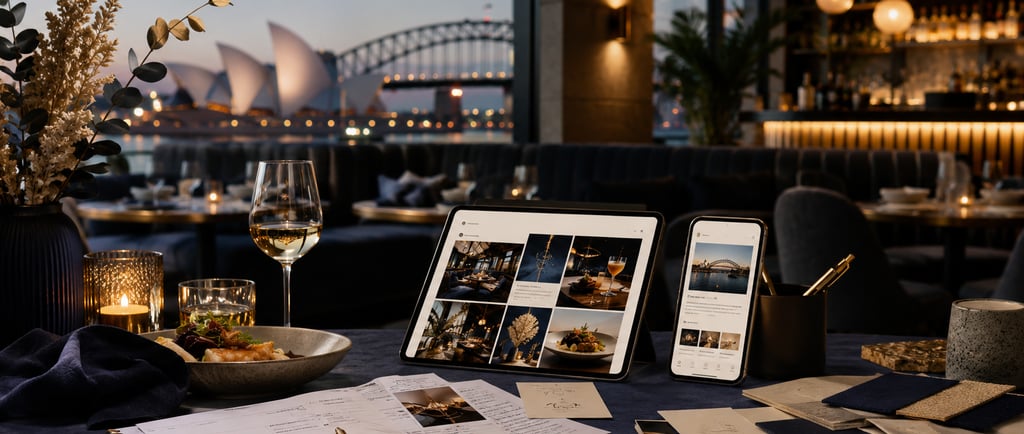
Hospitality Marketing for Sydney Venues: The Real Guide
A nice food photo isn't a strategy.
It used to be enough. Feeds were quieter, people paid less attention, and a good location did half the work for you. That's not the market anymore.
Now someone finds your venue on Instagram, checks your Google reviews, scans your menu, compares you with three other places, and decides whether to book — all in about five minutes, all on their phone.
That decision isn't built on one post. It's built on the full impression your venue gives online.
That's hospitality marketing. The way your restaurant, bar, café, function space, pub, or private dining room shows people what to expect, why they should trust you, and why you — not the place down the road.
Pretty posts help. They're just not the whole job.
What hospitality marketing actually is
It's the full system that helps people find you, trust you, remember you, and book you. Instagram, Facebook, your Google Business Profile, your website, your SEO, your reviews, your photos, your captions, your email list, your booking link — all of it, working together.
Not one channel. Not one campaign. Not three posts a week because someone told you the algorithm likes it.
Good hospitality marketing answers the questions people are already asking before they ever message you:
What's the food like? What's the vibe? Good for a date night or a big group? Is there parking? Can I book online without a phone call? Do people actually like this place?
If your content doesn't answer those, people keep scrolling.
The booking decision starts way before the booking link
Nobody goes from one reel straight to a reservation. They see your cocktails, tap your profile, check your tagged photos, Google your name, read a few reviews, look at the menu, then try the booking link on their phone.
Every one of those steps either builds confidence or plants doubt.
A strong feed creates interest. A clear website backs it up. A solid Google Business Profile gets you found when someone searches "Italian restaurant Surry Hills." Good reviews kill hesitation. A booking link that actually works turns interest into a table booked.
Weaken one link in that chain and you're leaking bookings somewhere you can't even see.
Food photos are not the whole story
A good food shot stops the scroll. It builds appetite. It reminds someone they've been meaning to book.
But people aren't only booking a plate of pasta. They're booking how it'll feel to be there.
Warm or stylish? Loud or intimate? Worth dressing up for, or rolling in straight from work? That's atmosphere, and it sells just as hard as the food does.
Show the lighting. Show the bar. Show the private dining room. Show the small details that make your venue feel like a place — not a menu with chairs attached.
A polished food shot says "that looks good." A full venue story says "I can picture myself there." Aim for the second one.
Local search is where the real bookings hide
For Sydney venues, this isn't optional. People search with real intent: "best brunch near me," "cocktail bar Darlinghurst," "wedding venue Inner West." Those aren't idle scrollers. They're often one decision away from booking.
That's why your Google Business Profile carries more weight than most venues give it. Updated hours, clear categories, fresh photos, working menu and booking links. If someone finds you on Google and the profile looks abandoned, trust drops before they've even seen your food.
Instagram builds the desire. Google catches the intent. You need both pulling their weight.
Reviews aren't separate from your marketing — they ARE your marketing
Before booking, people want proof. Good food, warm service, an experience that matches the photos. This matters even more for functions, weddings, and big group bookings, because the stakes feel higher. They're not just picking a place to eat — they're picking somewhere to bring people they care about.
Ask happy guests for reviews. Make it easy. Respond to every one, good or bad. Pull strong reviews into your content.
A thoughtful reply to a review tells a stranger there's a real person behind the business who actually cares. Silence makes a venue feel cold.
Your website is still doing a job — or it should be
A lot of venue owners build a website once and forget it exists. Big mistake. It's often where people land right before they decide to book.
It needs to be fast, clear, and built for a thumb, not a mouse. No hunting for the menu. No pinching and zooming. No six-page scroll to find the booking button.
The non-negotiables: visible menu, working booking link, hours, location, parking or transport notes, function and private dining info, strong photos, contact details.
If your site looks great on desktop and falls apart on someone's phone, you're making people work for the privilege of giving you money. They won't. They'll just move on.
Different content for different moments
A first-time visitor needs a reason to care. Someone comparing venues needs proof. A group organiser needs details. A past guest needs a reason to come back. Someone planning an event needs confidence your team can actually pull it off.
That's why content pillars matter — food, drinks, atmosphere, the people behind the place, reviews, events, functions, local area, seasonal offers, behind-the-scenes, menu updates.
All food and no atmosphere, people don't get the vibe. All atmosphere and no food, they don't know what they're eating. All promotion, all the time, and people tune out. Balance gives people the full picture, not a slice of it.
Everyday posting and campaigns are different jobs
Everyday content keeps you visible — your dishes, your team, your reviews, your weekend energy. A campaign pushes something specific: Valentine's Day bookings, Christmas functions, a new menu, a winter midweek special.
The mistake most venues make is turning every post into a campaign. "Book now." "Limited spots." "Don't miss out." That gets tiring fast, and people switch off before they ever get to the offer.
People need value and trust built up first. Then the call to action lands.
Match your content to the season, not the calendar you set in January
Sydney venues feel the swings — summer, Christmas functions, school holidays, EOFY, Valentine's Day, the winter quiet stretch, the Tuesday-night lull.
Peak periods need clear booking info, packages, and reminders to book early. Quiet periods need a reason to walk in at all — midweek specials, cosy winter content, after-work drinks, private dining pushes, local-community content.
Content that looks the same every month is missing the chance to speak to what people are actually thinking about right now.
Email still works — when it's not just noise
Social media gets you found. Email keeps you close to the people who already know you. New menus, seasonal events, function packages, loyalty offers, early access to private dining dates — all good reasons to open an email.
What's not a good reason: another generic newsletter with nothing in it. Your past guests already chose you once. Give them a real reason to do it again.
User-generated content builds trust your own posts can't
A guest's tagged photo or casual table shot often feels more believable than your polished brand content, simply because it's a real person, not a brand, choosing your venue.
That doesn't mean reshare everything. Quality still matters. But encourage tagging, reshare the good stuff, thank people, and save the strongest pieces for later. It should support your content, not replace it.
Paid ads amplify a strategy. They don't fix a broken one.
Ads can absolutely help — event bookings, seasonal offers, local awareness. But if your offer's unclear, your photos are weak, or your booking process is clunky, ads just send more people into a system that doesn't convert.
That's not growth. That's paying to find out your foundation isn't ready.
Get the basics sorted first: clear message, strong visuals, a website that works, an easy booking path, your Google profile sorted, reviews visible. Then ads can do their job properly.
A forgettable brand voice is still forgettable, even with great food
"Join us this weekend." "Book your table." "Good food, good vibes." None of it is wrong. All of it is invisible.
A premium restaurant shouldn't sound like a pub. A relaxed coastal café shouldn't sound like a corporate event space. Your words need to match the experience waiting for people when they walk in.
Clear voice helps people know what to expect before they arrive. It also makes you recognisable in a feed full of venues saying the exact same thing.
Hospitality marketing should feel like it actually belongs to your suburb
A café in Bondi, a bar in Newtown, and a private dining room in the CBD aren't talking to the same person in the same headspace. People choose venues based on location, occasion, and how connected a place feels to where it actually sits.
Mention your area. Speak to the people who are really walking through your door — locals, workers, tourists, couples, families, event planners. A venue that feels part of its neighbourhood is an easier yes than one that could be anywhere.
What actually makes hospitality content trustworthy
Clear, not oversold. Honest about what's on offer. Real reviews, not just curated ones. A menu that's easy to find. An atmosphere shown as it actually is, not styled into something unrecognisable.
Hospitality is personal. People are booking birthdays, dates, work lunches, weddings. If they're bringing other people along, their own reputation rides on the choice too. Good marketing makes that choice feel safe.
How to actually tell if it's working
Likes feel good. They don't fill a Wednesday night.
Track what's closer to the money: website visits, booking link clicks, Google profile views, direction requests, calls, enquiries, private dining leads, repeat bookings, email sign-ups.
Saves and shares are worth watching too — someone saving your private dining post might come back to book it in three weeks. Don't judge anything off a single post. Look for the pattern. Which content actually drives a click? Which offers get a reply?
The mistakes that show up again and again
No strategy is the big one. A few photos here, a rushed event post the week before, no clear pillars, no seasonal plan, nothing connecting your social to your Google profile to your website to an actual booking.
Other repeat offenders: only posting food, ignoring the Google profile, a website stuck in 2019, a menu nobody can find, weak calls to action, ignoring reviews, sounding exactly like every other venue, running ads before the basics are fixed, never showing the atmosphere, never promoting functions or private dining properly, never checking what's actually working.
Every single one of these is fixable. They just need a plan.
When it's time to bring someone in
If content's eating your week, posting feels random, or you're relying on last-minute promos to fill seats — that's the sign. Same goes if your social looks fine but doesn't bring enquiries, your Google profile's been neglected, or your function and private dining offers aren't getting any real promotion.
What you need isn't someone who posts generic captions and calls it a strategy. You need someone who looks at the whole picture — social, Google, website, reviews, SEO, content, campaigns, booking behaviour — and tells you straight where it's leaking.
The bottom line
Sydney hospitality is crowded. A great venue still gets overlooked if people can't understand the experience before they book.
Your marketing needs to show atmosphere, trust, personality, and proof — not just food. It needs to move people from "that looks nice" to "let's book."
That doesn't happen by accident. It happens when every piece of content has an actual job to do.
If your venue's content looks good but isn't bringing in enquiries, that's worth a proper look.
No Worries Digital helps Sydney hospitality venues build content that works harder than a pretty post. If you want to know exactly where your marketing is leaking bookings, book a content audit with us. We'll go through your social, your Google presence, your website, your content pillars, and your booking path — and tell you what to fix first.